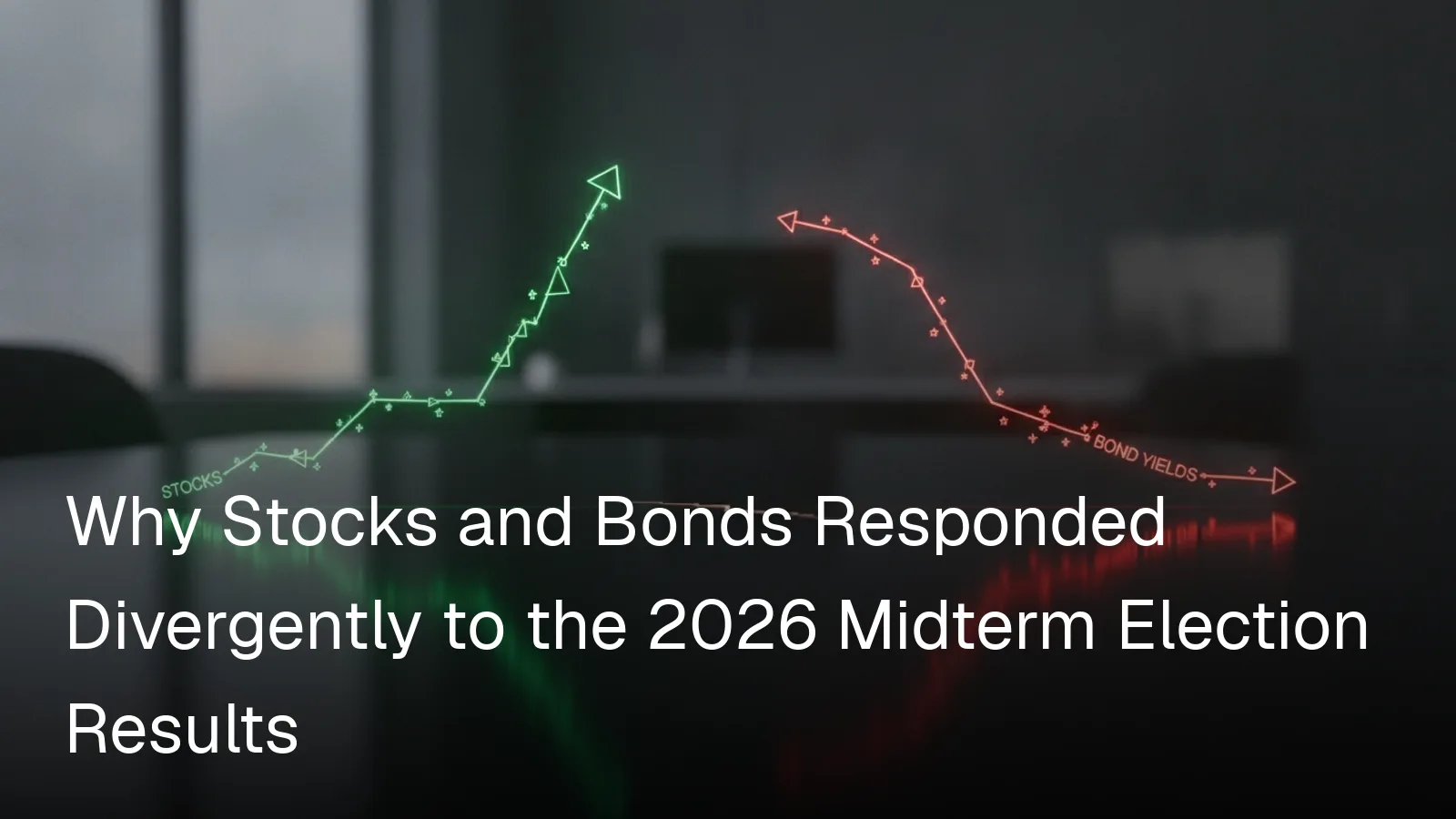
The 2026 U.S. midterm elections resulted in a significant political shift as Democrats secured control of both chambers of Congress. This outcome, which creates a divided government with a Republican presidency and a Democratic-led legislature, triggered immediate and distinct reactions across global financial markets. While major stock indexes surged to new heights, US Treasury yields declined, reflecting a complex investor response to the prospect of legislative gridlock and shifting regulatory priorities.
Equity Market Surge and Political Clarity
Global equity markets rallied following the confirmation of the Democratic sweep in the House and Senate. On November 4, 2026, the Dow Jones Industrial Average rose by 2.05%, while the S&P 500 and the Nasdaq Composite gained 1.72% and 2.46%, respectively. Market analysts noted that the midterm election market impact 2026 was driven largely by the removal of political uncertainty.
Before the results were finalized, markets had been weighed down by the ambiguity of the election outcome. The decisive nature of the Democratic victory, which included wins in traditionally Republican strongholds, provided a level of clarity that investors welcomed. This “resolution to a catalyst event” allowed markets to move past the election cycle, even as it raised new questions about the legislative agenda for the coming two years.
US Treasury Yields and Spending Expectations
In contrast to the rising stock market, US Treasury yields midterm elections saw a downward trend. Government bonds rallied as investors adjusted their expectations for federal fiscal policy. The move toward a divided government is often viewed by bond markets as a precursor to reduced government spending.
With Democrats controlling Congress and a Republican in the White House, the likelihood of significant new spending or borrowing plans is expected to diminish. This anticipated legislative gridlock typically limits the supply of new debt, which can put downward pressure on yields. Additionally, early volatility in the technology sector following the results briefly clouded the economic outlook, further supporting the demand for safe-haven Treasuries.
Sector Performance and AI Tech Regulation
The market reaction was not uniform across all industries. While broad indexes rose, specific sectors faced pressure due to anticipated shifts in policy.
Technology and AI Regulation
AI tech regulation market reaction was a focal point for investors. Initially, AI and tech-led stocks fell as results indicated a Democratic sweep. Investors anticipate that a Democratic-controlled Congress will apply more scrutiny to the artificial intelligence sector and potentially restrict the construction of new data centers.
While many of these stocks recovered their early losses, specific companies faced significant declines. Shares of Tesla and SpaceX, led by Elon Musk, fell sharply. Similarly, semiconductor firms such as Nvidia and Micron saw declines of more than 1% as markets priced in the potential for tighter oversight.
Energy and Defense
The energy sector emerged as one of the primary losers following the election. Crude oil prices dropped by 2%, with Brent oil falling below $95 per barrel. This decline was attributed partly to the political shift and comments regarding international conflicts. Meanwhile, defense stocks like Lockheed Martin also faced selling pressure, as investors weighed the possibility that additional defense funding plans might stall in a divided Congress.
Global Market and Currency Reactions
The impact of the U.S. midterms extended well beyond domestic borders. The MSCI All-World index rose by 1.3%, and Europe’s STOXX 600 climbed 1.84% to reach a two-month high. European markets were particularly buoyed by gains in clean energy and banking stocks. In Asia, AI-related shares initially led a decline before recovering to finish higher.
In currency markets, the U.S. dollar weakened against major peers. Both the euro and sterling gained ground against the dollar, with sterling reaching a seven-week high. This shift in currency valuation reflected a broader market recalibration as investors moved away from the dollar amid the changing political landscape.
Historical Context of Divided Government
Historically, midterm elections have a track record of influencing short-term stock performance without necessarily dictating long-term market trends. A divided government is often viewed favorably by equity investors because it tends to prevent radical policy changes that could disrupt corporate operations.
In the current 2026 context, the market appears to be pricing in a period of “policy stasis.” While regulatory scrutiny on technology and crypto markets may increase, the overall ability of the government to pass sweeping fiscal legislation is curtailed. For retail investors, this environment often shifts the focus back to fundamental economic data, such as labor market reports and corporate earnings, rather than purely political drivers.
This article is for general information purposes only and does not constitute financial or investment advice.
This article is for general information only and is not financial advice. Consider speaking to a licensed adviser before making financial decisions.
Sources
- World stocks rally as investors expect more political certainty after Democrats’ win (finance.yahoo.com)
- US stock markets and government bonds rally while dollar falls after Democrats secure Congress – as it happened | Business | The Guardian (theguardian.com)
- US stocks rally and oil prices ease following the Democrats’ sweep of the midterms | AP News (apnews.com)
- Tangled up in blue By Reuters (investing.com)
- Stock Market Today: Dow Soars 1,500 Points, Lockheed Socked; Breadth Goes Bullish (Live Coverage) (finance.yahoo.com)
- Stock market today: Dow, S&P 500, Nasdaq futures mixed after Democrats take control of House, Senate (finance.yahoo.com)
Written by
Nirmal Chhajed
Head Publisher