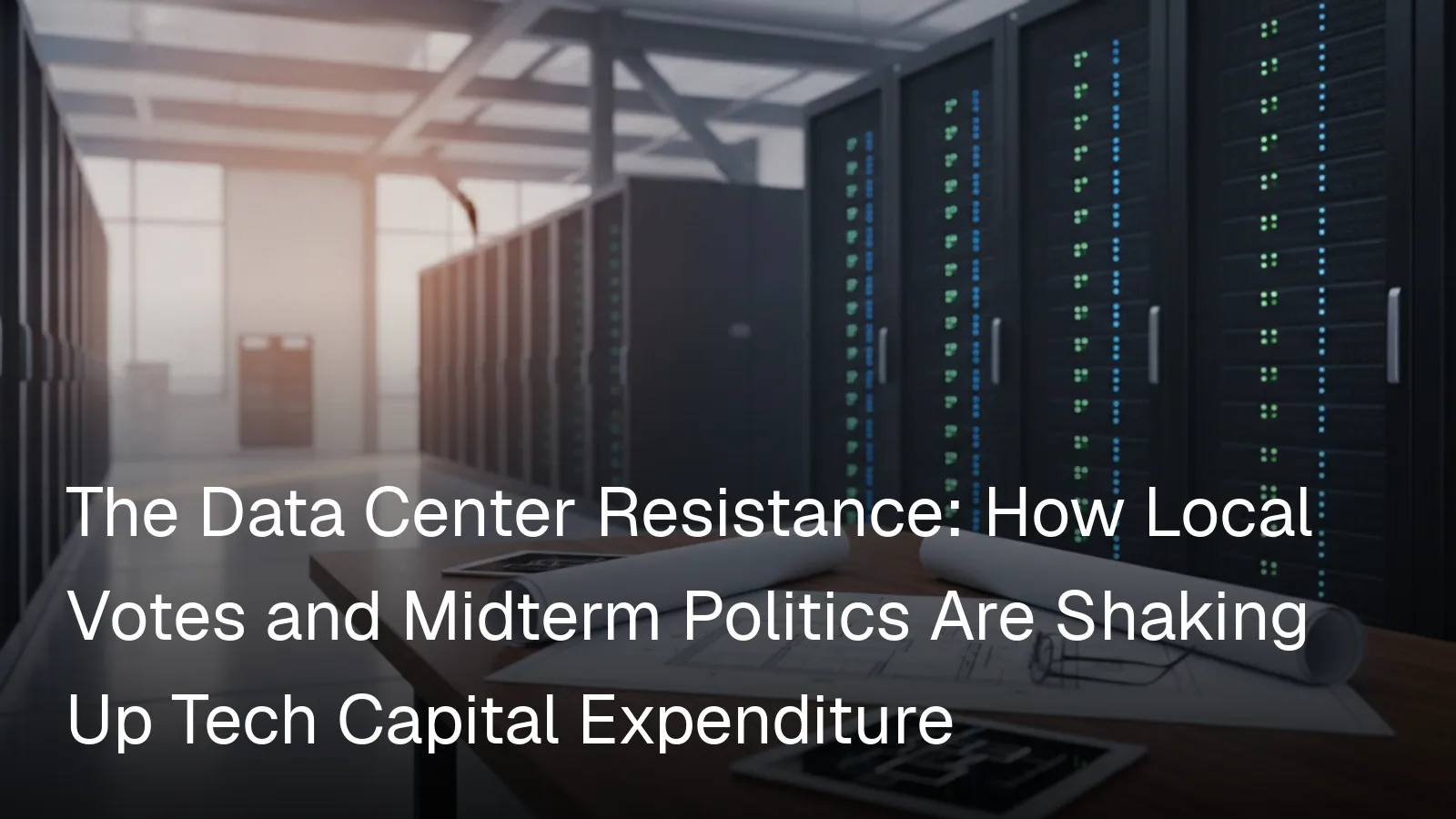
The multi-year surge in artificial intelligence investments has hit a sudden bottleneck not from silicon shortages or architectural limits, but at the ballot box. Following recent U.S. midterm elections, a wave of political shifts and community-level pushback against computational infrastructure has triggered sharp market realignments. Investors are reconsidering the speed at which physical capacity can be deployed, sparking a significant market pull-back across tech stock selloff events and broader AI capital expenditure plans.
While corporate executive teams previously focused on securing high-performance computing hardware and energy contracts, local governance, environmental permitting, and public opposition have rapidly emerged as central operational risks. Understanding this shift requires examining how municipal politics, financial cost structures, and strategic infrastructure planning intersect.
Midterm election shifts and the data center slowdown
The U.S. midterm elections marked a turning point for how local municipalities approach technology infrastructure. Candidates campaigning on promises to scrutinize, slow, or temporarily halt data center construction saw strong support across several states. In Texas, Democratic governor-elect Gina Hinojosa proposed a statewide moratorium on new data center permits, though projects already under construction would be exempt.
This legislative shift has forced an immediate reassessment of growth timelines. Political figures across newly flipped governorships, state attorneys general posts, and Congressional seats have pledged tighter regulation. As a result, market analysts expect the primary impact of these regulatory delays to materialize significantly from 2028 onward, while capacity scheduled to come online through 2027 remains relatively insulated because those facilities are already under construction.
In response to mounting public opposition, technology firms are attempting to reshape public perception. For example, OpenAI has sought to win over data-center opponents by renaming proposed sites as “compute campuses” and emphasizing local economic benefits.
Market fallout across AI semiconductor stocks and neoclouds
The political uncertainty prompted severe volatility across global equity markets. The tech-heavy Nasdaq Composite index experienced a single-day drop of more than 5.5% to 6.3%, shedding roughly $2.3 trillion to $2.5 trillion in market value.
The market reaction extended across the technology ecosystem, but affected firms unevenly depending on their business models and capital structures:
- AI semiconductor stocks: Hardware suppliers felt immediate pressure. Shares of chipmakers Micron and Nvidia dropped 7% and 3.17% respectively during the post-election selloff, while lackluster earnings reports from Qualcomm and Arm Holdings further amplified market anxiety.
- Infrastructure providers and neoclouds: Specialized AI infrastructure companies faced sharp drops. CoreWeave saw its shares plunge around 10%.
- Private market valuations: The public market volatility raised questions about private funding rounds and initial public offerings. Concerns emerged regarding whether AI lab Anthropic could maintain its targeted $1.5 trillion valuation in a planned IPO amid the turbulent market backdrop.
International markets reflected similar jitters, with Japan’s Nikkei 225 dropping 6.3% and the UK’s FTSE 100 falling approximately 2.2% following the U.S. trading sessions.
The emerging divide between hyperscalers and debt-funded operators
As data center infrastructure pushback restricts new development, a clear structural divide is forming between legacy tech giants and debt-dependent challengers. Financial analysts observe that tighter permitting rules may end up rewarding established hyperscalers while squeezing smaller market entrants.
Hyperscalers like Microsoft and Amazon surged over 6% immediately following the initial market reaction, even as broader indexes fell. Because existing capacity becomes substantially more valuable when new supply is constrained, companies holding operational data centers possess an immediate competitive advantage.
Furthermore, borrowing costs have diverged significantly:
- Hyperscalers: Established balance sheets allow large tech firms to raise capital at lower borrowing spreads, insulating them from sudden interest rate or political shocks.
- Neoclouds: Debt-funded specialized cloud providers face significantly higher borrowing costs. As capital spreads widen, raising additional funds to build out speculative capacity becomes far more expensive.
Strategic adjustments for enterprise infrastructure planning
To navigate the data center slowdown, technology executives, institutional investors, and enterprise strategists are shifting away from rapid, unconstrained site acquisitions toward more disciplined deployment strategies.
Prioritizing brownfield sites and existing permits
Because new greenfield permits face heavy community scrutiny and legal delays, infrastructure developers are shifting focus to brownfield locations and industrial zones with pre-existing power allocations. Securing locations where construction is already underway helps shield capital projects from sudden moratoriums or localized political changes.
Localized economic alignment
Expanding infrastructure now requires early community engagement. Provider strategies are shifting from simple land buys to comprehensive community frameworks that guarantee local grid investments, water conservation commitments, and tax contribution structures. Renaming facilities to reflect research and educational hubs—such as compute campuses—is part of this broader public relations realigning.
Diversifying capital structures
With debt-funded expansion becoming cost-prohibitive for smaller infrastructure operators, companies are cutting corporate capex forecasts to maintain cash flow discipline. Joint ventures with institutional real estate funds and utility providers are increasingly replacing pure debt financing for large-scale builds.
Frequently asked questions
Why are local communities opposing new data center projects?
Local opposition is primarily driven by concerns over community resource allocation, including high water usage for cooling systems, heavy electrical grid demand, noise levels from continuous cooling infrastructure, and local land use priorities.
How does community opposition affect large chipmakers?
If physical data center builds are delayed by permitting backlogs or local moratoriums, hyperscalers and cloud providers cannot deploy new server racks. This creates a delayed drop in hardware orders, affecting revenues for semiconductor suppliers.
Are existing data centers affected by new state moratoriums?
Proposed regulatory moratoriums, such as the framework outlined in Texas, typically target new permit applications. Facilities already under construction or currently operational are generally exempt from prospective development bans.
Sources
- Latest Business News & Updates | Fortune | Section (fortune.com)
- US tech stocks edge up after AI slowdown fears hit value of firms – live updates – BBC News (bbc.com)
- Stocks tumble as midterms fuel AI fears and judge halts Trump’s D.C. arch: Morning Rundown (nbcnews.com)
- Our top 10 things to watch in the stock market Friday (cnbc.com)
- U.S. midterms could widen AI data center divide (cnbc.com)
- AI, data-center stocks slip as Democratic sweep clouds expansion plans By Reuters (investing.com)
Written by
Karan Agrawal
Head Strategist