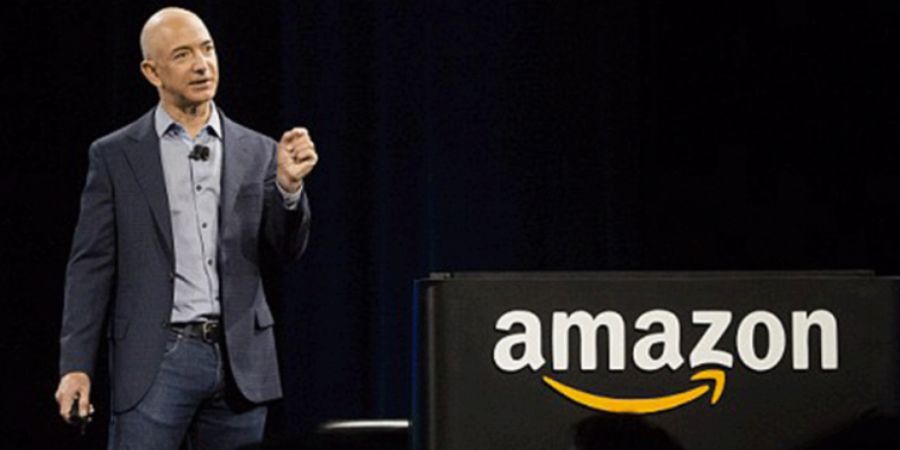
Have you ever thought of launching a business in a garage, only to sell a single product, and then grow it into one of the most valuable and powerful companies in the world? Well, that is exactly what Amazon did. The company which was originally a simple online bookstore in the 90s has since changed the way the world does business. Besides retail, Amazon is now a major player in cloud computing, digital streaming, logistics, and even artificial intelligence.
Why should this story matter to you? The Amazon success story works like a roadmap for how a bold idea, deep customer focus, and long term thinking can reform entire industries. Any entrepreneur, leader, or simply a person curious about what it takes to create something big, can find the lessons in every stage of its story.
This article explains how Amazon became successful through the right strategy, calculated risk taking, and continuous innovation.
The Founder: Jeff Bezos
Jeffrey Preston Bezos is the American businessperson who took Amazon off the ground and turned it into a worldwide empire. Born in Albuquerque, New Mexico, January 12, 1964, to Jacklyn and Ted Jorgensen. His mother was only 17 years of age when he was born, and his biological parents separated when he was still very young. When he was four years old, his mother married Miguel “Mike” Bezos, a Cuban immigrant who adopted him and with whom he shared his formative years.
Bezos was dependent on his curiosity to learn how things work and his passion for science and technology. As a young boy, he was into dismantling and building things and was supported by his grandfather in this. Later his parents moved the family to Houston where he first went to River Oaks Elementary School and then they relocated to Miami, Florida.
He was a very bright student. While in high school he was the valedictorian and a National Merit Scholar. He kept on the same track of academic excellence at Princeton University by obtaining his degree with the highest honors in electrical engineering and computer science in 1986.
After graduation, Bezos went to work for several companies in New York among which were Fitel and Bankers Trust. Afterward, he became a partner at D.E. Shaw & Co., a New York investment firm where he was promoted to youngest senior vice president mainly due to his logical skills and management abilities. Contrary to the idea of a bright career in Wall Street, he came up with a better idea turn into the internet world. He decided to quit his job and make a new start when he was 30 years old. His concept was very straightforward: create a business which could sell goods to anyone via the internet. It went on to be Amazon.
Amazon Success Story: Humble Beginnings
Jeff Bezos, in the summer of 1994, gave up his stable career at Wall Street and decided to follow a daring idea: establish a business on the internet. While he was investigating potential business ventures, he noticed that the internet was being used more and more and he was certain that if products were sold online, it would revolutionize the way people buy things. To make that dream come true he relocated to Bellevue, Washington and started to work on what would later be known as Amazon.
Bezos first established the company on July 5, 1994, under the name Cadabra, Inc. Shortly after that he changed the name to Amazon because he wanted it to be listed among the first in alphabetical listings and also to signify that the business would be as vast as the Amazon River.
At the very beginning, the office was quite simple. Amazon was started in the garage of Bezos’s rented house in Bellevue, Washington. That little place was the center of the early operations. Bezos worked on the site using a few personal computers and kept track of the books. MacKenzie Scott, his wife at that time, and she took care of the office work, which included bookkeeping and logistics.
Bezos decided on books as the first goods to be sold online because of very obvious reasons. The sheer number of book titles in the world was (and still is) much more than what any brick-and-mortar bookstore could stock, and buyers of books were already used to relying on descriptions and reviews. No other retailer could compete with that selection for a while yet to come.
On July 16, 1995 Amazon.com opened its virtual doors to the public as an online bookstore. People from the whole United States and even other countries could check through and order the books by using the website, which was quite an innovative thing to do back then. Within the first week Amazon recorded sales amounting to thousands of dollars in books, therefore proving that the business model was viable.
During that period, Bezos and his small team of workers personally took care of the packing and if a post office was far away they drove the parcel there. Promptness and customer service were some of the things that the company focused on from day one. A future growth strategy was developed by adopting such a small-scale approach.
Bezos had never stopped dreaming of a far bigger afterlife for Amazon than it was at the time of the first book sale. With the book business becoming the foundation upon which the company could run into music, video, and then all the other major product categories, this phase marked the real beginning of the Amazon growth story, which started in that little garage.
Early Growth and Public Listing
Amazon didn’t wait long to broaden its offerings after the launch, a key phase in understanding how Amazon became successful. It went public on the NASDAQ stock exchange in 1997 at $18 per share, thus raising $54 million for investing in its growth.
Its rise to success was mainly due to the two factors – an extensive choice of goods and customer convenience while making the purchase, and as a result, short-term profits were ignored. This approach became the foundation of the Amazon business model, which prioritized scale, customer trust, and long-term growth over immediate profitability.
This survival strategy based on a far-sighted plan enabled Amazon to survive the dot-com crash of 2001 when a great number of internet companies went bankrupt. In fact, Amazon made its first profit that year, thus confirming that its model was viable.
Becoming the Everything Store: How Amazon Became a Global Giant
After dominating the book market, Amazon set its sights on becoming the everything store, a strategic move that shows how Amazon became successful at building long term scale. Over the first decade of the new millennium, Amazon broadened its product categories and international operations.
Meanwhile, the company was also transforming the way it built its infrastructure. In 2006, Amazon introduced Amazon Web Services (AWS), a set of cloud computing tools that gave businesses the option to rent their computing power. AWS, in fact, was the reason why Amazon became one of the most profitable companies and a global leader in cloud services.
These decisions were deliberate, not random. Bezos was big on long-term thinking and continuous innovation. His playbook revolved around customer obsession, invention, and treating Amazon as if it were still a startup even though it had become enormous.
Expanding Beyond Retail
Amazon kept diversifying. It introduced technologies and services that changed industries:
- Amazon Prime: A subscription program offering fast shipping, digital content, and exclusive deals that strengthened customer loyalty. Prime became a powerful engine for retention and revenue growth.
- Amazon Echo and Alexa: Voice-activated devices and smart assistants that positioned Amazon as a technology innovator.
- Whole Foods Market acquisition: In 2017 Amazon bought Whole Foods for $13.4 billion, pushing into physical retail and grocery.
- Entertainment: Amazon Prime Video became a major player in streaming, producing original shows and competing with traditional media companies.
These expansions demonstrate how Amazon used customer-centric thinking to grow beyond a simple ecommerce site.
Evolution of Leadership and Today’s Vision
In 2021, Bezos left his position as CEO and took on the role of Executive Chairman. Andy Jassy, formerly the head of AWS, was appointed CEO. The change in Bezos’s leadership was a clear sign of Amazon’s evolution and its firm commitment to changing its way of looking ahead.
After Jassy took over, Amazon kept on spending the company’s money on cutting-edge technology, automation, and artificial intelligence with the goal of making their logistics and user experience better on a large scale.
Five years later, in 2025, Amazon made public its plan to invest a staggering $35 billion in India over the next five years to develop logistics, AI capabilities, and the local business sector. The company is showing here that it has a worldwide ambition and that it is willing to stay for a long time in the emerging markets.
Amazon’s Impact on the World
Currently, Amazon is not just a typical ecommerce company. It still affects how businesses function and customers shop and interact with technology. Some of the substantial effects that can be measured are:
- Revenue growth: Amazon is regularly one of the top companies in the world in terms of revenue with its annual sales going up to several hundreds of billions.
- Cloud dominance: AWS is a leader in cloud computing, a platform that is open to thousands of companies and services.
- Jobs and economic impact: Amazon is the source of millions of job opportunities worldwide, both directly and indirectly.
- Small business growth: By means of marketplaces and seller services, Amazon gives an opportunity to small and medium businesses to access customers all over the world.
The extent of Amazon is enormous. Its ecosystem comprises online retail, cloud computing, logistics, entertainment, devices, AI, and even grocery.
What Makes Amazon Successful
A couple of factors, among others, can be easily singled out from Amazon’s phenomenal success:
- Relentless focus on the customer: The enterprise is orientated to the customer’s needs and wants, even when it entails a higher cost for the first time.
- Innovation with a reason: Amazon does not come up with an innovation just for the sake of a novelty. It innovates to solve issues that are genuine or to make the user’s experience better.
- Long-term strategy: Instead of looking for gains of the next three months, Amazon chooses to make investments that will increase its capabilities and open new markets in the future. This principle sits at the core of the Amazon business model.
- Scalable infrastructure: AWS and logistics systems are not simply mechanisms for the company to spend money on, but rather, they are platforms for growth.
These guidelines are deeply rooted in the company’s choices, from technology investments to global expansion.
Conclusion
Amazon success story is essentially a guide for understanding how Amazon became a global giant and what it takes to build a company for the long term. The company initially was just a very simple idea: selling books over the internet, but eventually, it became a mighty empire that changed both the way we do business and technology. What is most significant about this journey is not luck but rather it is strategy, customer insight, and the readiness to question the very nature of business that stands out.
It is a story of revolution of Amazon, the transformation of a small business out of a garage into a leader of the world, which serves as a beacon of boldness and trustfulness in the power of ideas and their tremendous effect if they are followed with discipline and focus.
Still, Amazon is perpetually funding innovations and new industries in the future to be able to influence the ways the coming generation will shop, compute, and connect.