NASA forecasts that Voyager 1 will reach a distance of one light-day on 18 November. The milestone describes distance and signal delay, not a journey completed in a day.
When is Voyager 1 expected to reach the milestone?
NASA says Voyager 1 is expected to reach a distance of one light-day from Earth on Wednesday, 18 November 2026, at 5:16:07 AM Eastern Standard Time. That is 10:16:07 UTC, or 3:46:07 PM in India. As of this article’s 14 November preparation, the milestone is still ahead. [1]
A light-day is the distance light travels in 24 hours, approximately 16 billion miles or 26 billion kilometres. It is a unit of distance, not the time Voyager took to travel there. NASA says the spacecraft will have been travelling for more than 49 years. [1]
Why does the distance matter for communication?
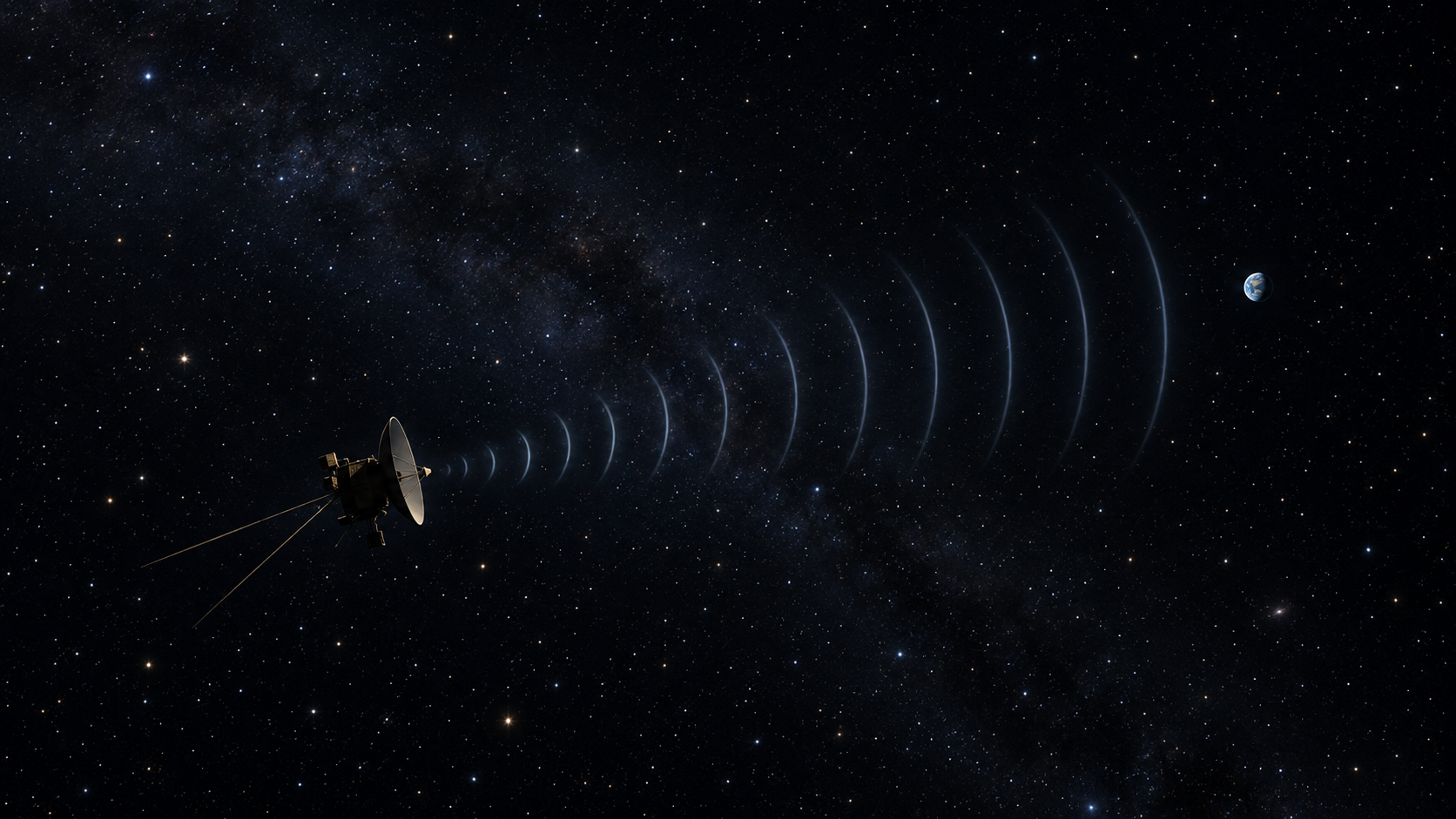
Radio signals travel at the speed of light. At a distance of one light-day, a signal sent between Earth and the spacecraft takes about 24 hours to travel one way. An exchange requiring a signal to reach the spacecraft and a reply to come back therefore involves roughly two days of travel time alone. [1]
That delay helps explain why operating a distant spacecraft cannot resemble a real-time remote-control session. The milestone is a measure of the mission’s reach and longevity, not a claim that the probe is moving at the speed of light. [1]
Where is Voyager 1?
Voyager 1 crossed the heliopause into interstellar space in 2012. The heliopause is the outer boundary of the Sun’s heliosphere, the bubble formed by the solar wind. That boundary crossing and the coming light-day distance are different milestones. [1][2]
Reuters reports that Voyager 1 launched on 5 September 1977 and visited Jupiter and Saturn before continuing outward. Its twin, Voyager 2, launched earlier in 1977, followed a different route and entered interstellar space in 2018. [2]
What should not be overstated?
The forecast concerns distance from Earth at a particular time. It does not mean Voyager has reached another star or that the mission’s scientific work is finished. NASA presents the milestone as an opportunity to recognise an unusually long-running exploration mission. [1]
NASA’s announced crossing time remains a forecast as of 14 November. The achievement to watch is confirmation that the spacecraft has passed that distance, followed by the continued return of data across an increasingly long communications link. [1]
Sources checked 14 November 2026
- NASA Science: Voyager 1, what is a light-day https://science.nasa.gov/mission/voyager/voyager-1/voyager-1-what-is-a-light-day/
- Reuters via Devdiscourse, 14 November 2026: Voyager 1’s approaching milestone https://www.devdiscourse.com/article/international/4006971-nasas-voyager-1-probe-poised-to-achieve-mega-distance-milestone
Cover: AI-generated editorial illustration, not an event photograph or scientific observation.