The European Space Agency’s DR1-Foundation release opens a large new dataset to researchers. It is a foundation for the mission’s map, not a finished answer to dark matter or dark energy.
What has Euclid released?
The European Space Agency released the first major batch of data from its Euclid mission on 12 November. Called DR1-Foundation, it contains observations of more than 900 million galaxies and around 13 months of survey work, according to ESA. [1]
The release covers 1,900 square degrees of sky. That is about 14% of the sky area the mission plans to survey, rather than 14% of the entire sky. ESA compares the area with roughly 9,500 full Moons as viewed from Earth. [1][2]
Why are astronomers interested?
Euclid is designed to study the large-scale structure of the Universe and help scientists investigate dark matter and dark energy. Its images and spectra provide different kinds of information: images show the appearance and distribution of objects, while spectra split their light to help researchers study properties including distance. [1][2]
ESA says the dataset includes spectra from more than 160 million sources, around 15,000 strong gravitational-lensing candidates and more than 60 million quasar candidates. The word candidates matters: these are categories for scientific investigation, not a statement that every object has already been individually confirmed. [1]
Is this the completed three-dimensional map?
No. The release supplies data from which researchers can begin building a more detailed three-dimensional view. ESA says the full Data Release 1 is due in mid-2027 and will add further material, including weak-lensing observations and information on how galaxies and galaxy clusters fit into the cosmic web. [1]
The Paris Observatory describes DR1-Foundation as a basis for upcoming scientific studies. Its researchers point to uses beyond cosmology, including work on galaxy clusters, dwarf galaxies, quasars and transient phenomena. [2]
What should readers watch next?
The next stage is analysis, not an instant solution to the Universe’s biggest questions. Scientists need to examine the data, measure distances and test models. A large data release can support many discoveries without itself proving a new explanation for dark energy or dark matter. [1][2]
Euclid launched in 2023. This release marks a change in the amount of survey data available to the research community, with further results expected as the mission continues. [1]
Sources checked 14 November 2026
- ESA, 12 November 2026: Euclid DR1-Foundation release https://www.esa.int/articles/about-us/directorates/science/euclid/euclid-lays-the-foundation-for-its-best-ever-3d-map-of-the-universe
- Paris Observatory, 12 November 2026: data-release scope and scientific uses https://observatoiredeparis.psl.eu/euclid-dr1-foundation-first.html
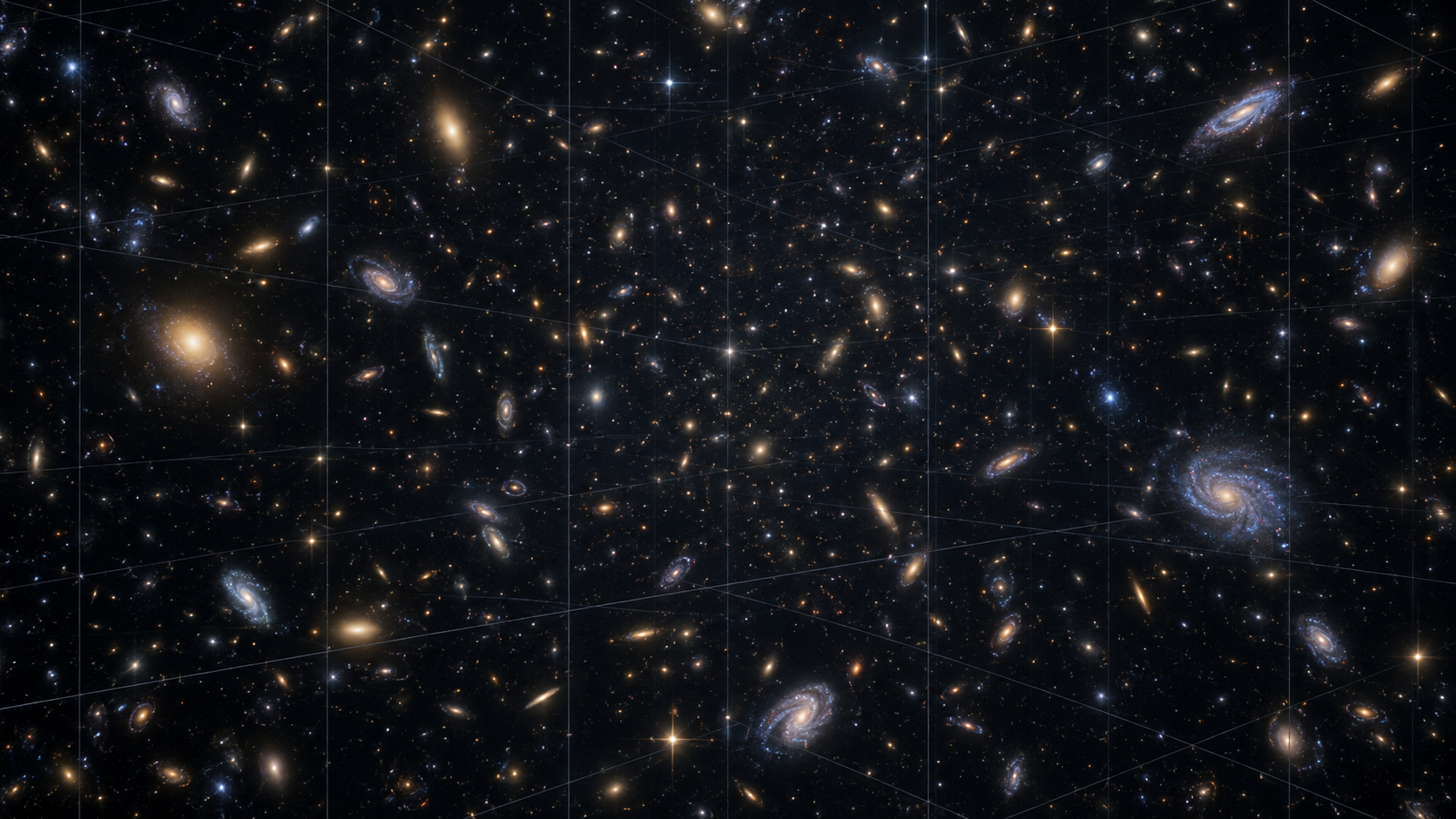
Cover: AI-generated editorial illustration, not an event photograph or scientific observation.