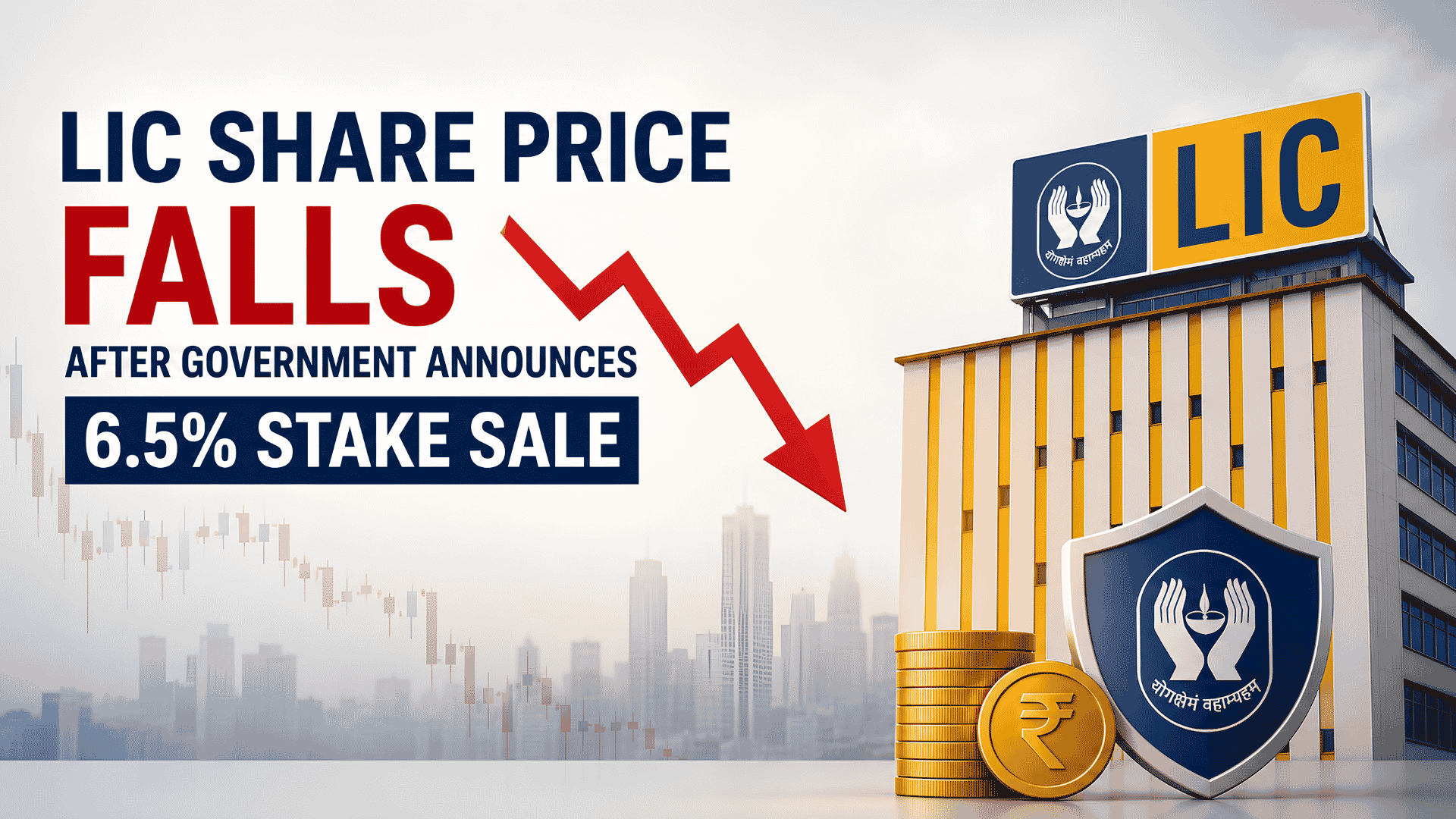
The LIC share price came under pressure on Tuesday after the Government of India launched an Offer for Sale (OFS) to divest up to 6.5% of its stake in Life Insurance Corporation of India (LIC). The move, aimed at increasing public shareholding and raising nearly ₹31,000 crore, has become one of the biggest developments in the Indian stock market this year.
The government has fixed the floor price at ₹382 per share, which is lower than the previous market closing price. The discounted pricing triggered heavy selling in the stock, leading the LIC share price to fall sharply during early trading. Investors are now closely watching whether the OFS receives strong demand and how it impacts the company’s valuation in the coming months.
The stake sale will begin with institutional investors, followed by retail investors, allowing both categories to participate in the offering. The government will initially sell a 2% stake, while retaining the option to sell an additional 4.5% if demand remains strong. If fully subscribed, the sale could generate around ₹31,400 crore, making it one of India’s largest disinvestment exercises in recent years.
One of the key reasons behind the government’s decision is to meet the minimum public shareholding norms mandated by market regulators. Currently, public investors own only about 3.5% of LIC, while regulations require listed companies to maintain at least 10% public shareholding. This OFS will help LIC move closer to that requirement before the regulatory deadline in May 2027.
The announcement had an immediate impact on the market. The LIC stock declined as investors reacted to the discounted offer price and the possibility of additional shares entering the market. Large stake sales often create short-term pressure on stock prices because of increased supply, even though they may improve liquidity over the long run.
Despite the temporary decline, market analysts believe the stake sale does not change LIC’s core business fundamentals. As India’s largest insurance company, LIC continues to dominate the life insurance sector with millions of policyholders, an extensive distribution network, and strong brand recognition. Many long-term investors may see the lower OFS price as an opportunity to invest at a discount, depending on their investment strategy and market outlook.
The stake sale is also an important part of the government’s broader disinvestment programme. The Centre has set ambitious divestment targets for the financial year and has already raised significant funds through stake sales in other public sector companies. Selling a part of its holding in LIC helps the government generate capital while improving public participation in one of India’s largest listed companies.
For retail investors, the LIC OFS offers an opportunity to purchase shares at the announced floor price, subject to the terms of the issue. Investors should, however, evaluate factors such as market volatility, LIC’s long-term growth potential, and overall economic conditions before making investment decisions.
The coming days will be crucial for the LIC share price as the market gauges investor response to the OFS. Strong subscription levels could improve confidence, while weak demand may continue to weigh on the stock in the short term. Regardless of the immediate market reaction, the government’s latest move marks another significant milestone in India’s ongoing public sector disinvestment strategy.
As investors continue tracking the LIC share price, LIC OFS, and the government’s disinvestment plans, this development is expected to remain one of the biggest talking points in the Indian stock market this week.
Stay tuned to Article Basket for more updates on the stock market, business news, investment trends, and the latest financial developments.