Every planet in our solar system has a name. But most people never stop to ask, why that name?
The answer almost always leads back to ancient Rome.
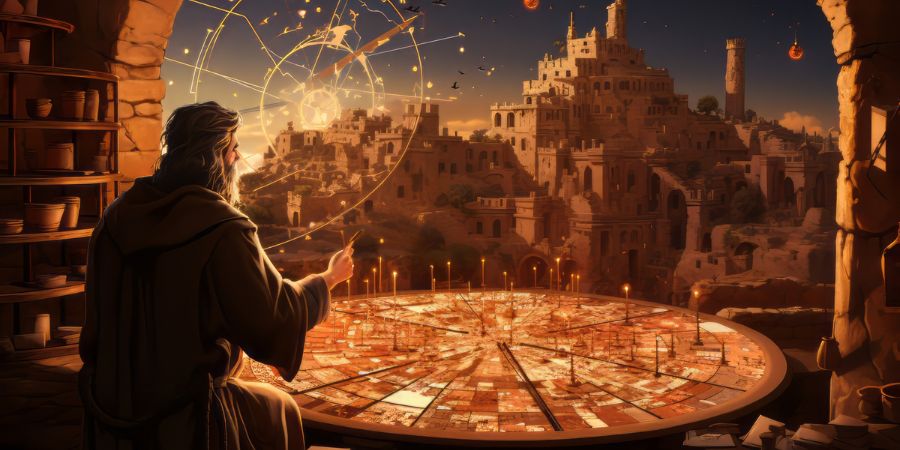
Romans looked up at the night sky and saw moving lights, planets, and matched them to gods based on how they behaved. Fast, slow, bright, red. Each planet reminded them of a god. And one planet moved faster than all the others.
That planet is Mercury, named after the Roman god of trade, skill, speed, and communication.
If you searched “which planet is named after the Roman god of trade,” the answer is Mercury. Simple.
But the full story is far more interesting.
The Planet Named After the Roman God of Trade
Mercury stands as the closest planet to the Sun and functions as the smallest planet in the solar system. The planet completes its solar orbit within a time period of 88 Earth days which makes it the fastest planet in the solar system.
The ancient Romans selected this name for the planet because of its fast movement across the night sky.
The ancient Romans believed that only one god named Mercurius could receive the name of a planet which moved across the night sky at such high speeds.
Who Was the Roman God Mercury?
Mercury, or Mercurius in Latin, was one of the most important gods in ancient Rome.
He was the god of:
- Trade and commerce
- Merchants and travelers
- Communication and language
- Thieves and tricksters (yes, really)
- The guide of souls to the underworld
He wore a winged helmet and carried a staff called the caduceus. Those wings were not just decoration, they represented his defining quality: speed.
Mercury was the messenger of the gods. Jupiter needed something delivered? Mercury was there before you blinked. He moved between worlds, from Olympus to Earth to the underworld, faster than any other god could.
Romans trusted Mercury with everything that required quick movement: news, trade routes, merchant ships, and travelers on long roads. Merchants prayed to him before journeys. Traders kept small statues of him in their shops.
His Greek equivalent was Hermes, another name you may recognize in modern words like “hermeneutics” (the study of interpretation) and “hermetic” (sealed airtight, referencing Hermes’s power to move between worlds).
Why Was the Planet Named Mercury?
Ancient sky-watchers, Babylonians, Egyptians, Greeks, and Romans, all observed the same thing: one bright object near the horizon moved across the sky at an almost startling pace compared to others.
The Romans formalized the naming system we still use today. Their logic was visual and intuitive:
- Mars was red – like blood and war
- Venus was the brightest and most beautiful
- Jupiter was the largest and most dominant
- Saturn moved slowest – like an old, patient ruler
- Mercury moved fastest – like a running messenger
Mercury’s orbit of 88 days means it laps Earth repeatedly throughout the year. Ancient observers could watch it dart from one side of the Sun to the other in just weeks. No other visible planet moved that quickly.
To a Roman watching the sky in 100 BCE, that planet could only belong to one god.
The name stuck, through the Roman Empire, through the Middle Ages, and into the age of modern astronomy. Today, every space agency on Earth, NASA, ESA, JAXA, uses the name Mercury without question.
Other Planets Named After Roman Gods
Mercury is not alone. Almost every planet in our solar system carries a Roman god’s name.
- Mars: God of War. The planet’s red color reminded Romans of blood and battle. Mars was Jupiter’s son and one of Rome’s most worshipped gods, protector of the Roman army.
- Venus: Goddess of Love and Beauty. Venus is the brightest object in the night sky after the Moon. Romans gave it to their goddess of beauty because nothing in the sky looked more radiant.
- Jupiter: King of the Gods. Jupiter is the largest planet in the solar system. Romans named it after their most powerful god, the ruler of Olympus, god of thunder and lightning.
- Saturn: God of Agriculture and Time. Saturn moves slowly across the sky. Romans linked its slow, patient movement to their ancient god of harvests and the passage of time. Saturday is named after Saturn.
- Neptune and Uranus were discovered much later, in 1846 and 1781 respectively, but astronomers kept the Roman tradition alive. Neptune, deep blue and distant, was named after the god of the sea. Uranus was named after the ancient Greek god of the sky (one of the few Greek names in the group).
- Earth is the only exception, its name comes from Old English and Germanic words meaning “ground” or “soil.”
Interesting Facts About the Planet Mercury
Most people know Mercury as “the closest planet to the Sun.” But there is more to it than that.
- It is tiny. Mercury is only slightly larger than Earth’s Moon. Its diameter is about 4,880 kilometers, less than half of Earth’s. You could fit Mercury inside Earth roughly 18 times.
- It moves incredibly fast. Mercury travels at about 47 kilometers per second around the Sun. Earth moves at roughly 30 km/s. Mercury’s speed is what made it so obvious to ancient sky-watchers.
- It has extreme temperatures. Mercury has almost no atmosphere to trap heat. During the day, temperatures reach 430°C (800°F). At night, they drop to -180°C (-290°F). That is a swing of over 600 degrees, one of the most extreme temperature ranges in the solar system.
- A day on Mercury is longer than its year. Mercury rotates so slowly that one full rotation takes about 59 Earth days. But its year one orbit around the Sun, takes only 88 days. So Mercury experiences fewer than two sunrises per year.
- It has been visited by spacecraft. Two missions have studied Mercury up close:
- Mariner 10 (1974–1975): First spacecraft to visit Mercury. It mapped about 45% of the surface.
- MESSENGER (2004–2015): NASA’s dedicated Mercury orbiter. It spent four years mapping the entire planet, discovering water ice inside permanently shadowed craters near the poles.
- BepiColombo (launched 2018, arriving 2025): A joint ESA and JAXA mission currently en route to Mercury for the most detailed study yet.
How Ancient Mythology Shaped Modern Astronomy
It is easy to forget how recent modern science is.
For thousands of years, humans understood the sky through stories. The Babylonians tracked planets as early as 1700 BCE. The Greeks built complex mathematical models of their movements. The Romans added their gods’ names, and those names became the universal standard.
When Galileo pointed his telescope at Jupiter in 1610 and discovered four moons orbiting it, he named them after figures from Jupiter’s mythological story. When astronomers discovered new features on Mercury, they followed the same tradition, naming craters after great artists, musicians, and writers.
Today, NASA’s crater naming conventions for Mercury use the names of artists who have “made outstanding or fundamental contributions to their field.” Craters are named after Bach, Tolkien, Shakespeare, Beethoven, and hundreds of others.
The mythology gave way to science. But the names carried something important forward: a sense that the sky is not empty. It is full of stories.
Frequently Asked Questions
Which planet is named after the Roman god of trade?
Mercury. The planet was named after Mercurius, the Roman god of trade, merchants, communication, and speed, because of how quickly it moves across the sky.
Why is Mercury associated with commerce and trade?
In Roman mythology, Mercury was the protector of merchants, travelers, and anyone involved in exchange, whether of goods or information. He represented the movement of things from one place to another, which matched perfectly with how the planet itself moves rapidly around the Sun.
Which planets are named after Roman gods?
Mercury, Venus, Mars, Jupiter, Saturn, and Neptune are all named after Roman gods. Uranus is named after a Greek god. Earth is the only planet with a non-mythological name.
Is Mercury the fastest planet in the solar system?
Yes. Mercury orbits the Sun faster than any other planet, completing one full orbit in just 88 Earth days and traveling at approximately 47 kilometers per second.
What is Mercury’s connection to modern language?
The word “mercurial,” meaning quick, unpredictable, and clever, comes directly from the god Mercury. The element mercury (quicksilver) was also named for the god, because the liquid metal moves quickly and unpredictably, just like the planet and the deity.
Did other ancient cultures also name this planet after speed?
Yes. The Babylonians called it the “jumping planet.” The ancient Egyptians associated it with the god Thoth, their god of writing and wisdom. The Greeks called it Hermes, their own messenger god. Every culture that watched this planet noticed the same thing: it was always in a hurry.
Conclusion
The planet Mercury is named after the Roman god of trade, skill, speed, and communication, and the name fits almost too perfectly.
A god defined by his speed. A planet that outpaces everything else in the solar system. Ancient Romans did not have telescopes or orbital calculations. They just watched, noticed patterns, and told stories that made sense of what they saw.
Those stories turned into names. Those names became the standard for every astronomy textbook, space mission, and star map on Earth today.
So the next time you spot a bright light near the horizon just after sunset or before sunrise, moving noticeably faster than everything around it, you are watching the same thing Roman sky-watchers saw 2,000 years ago.
And just like them, you are watching Mercury. Always in motion. Never staying still.