Artificial intelligence has quickly moved from being a tool for answering questions to becoming part of everyday work. People are using AI to write, research, analyze information, create software and automate repetitive tasks.
One name getting increasing attention in 2026 is Claude AI, developed by Anthropic.
While Claude started as an AI assistant for conversation and writing, it has expanded into coding, professional work, research and agentic workflows. Anthropic’s latest platform updates show how quickly the Claude ecosystem is developing, with new models and tools designed for increasingly complex tasks.
So, what exactly is Claude AI, and why are so many people talking about it?
What Is Claude AI?
Claude AI is Anthropic’s family of artificial intelligence models and applications. Like other generative AI tools, it can understand natural-language instructions and generate responses, but its uses go far beyond simple conversations.
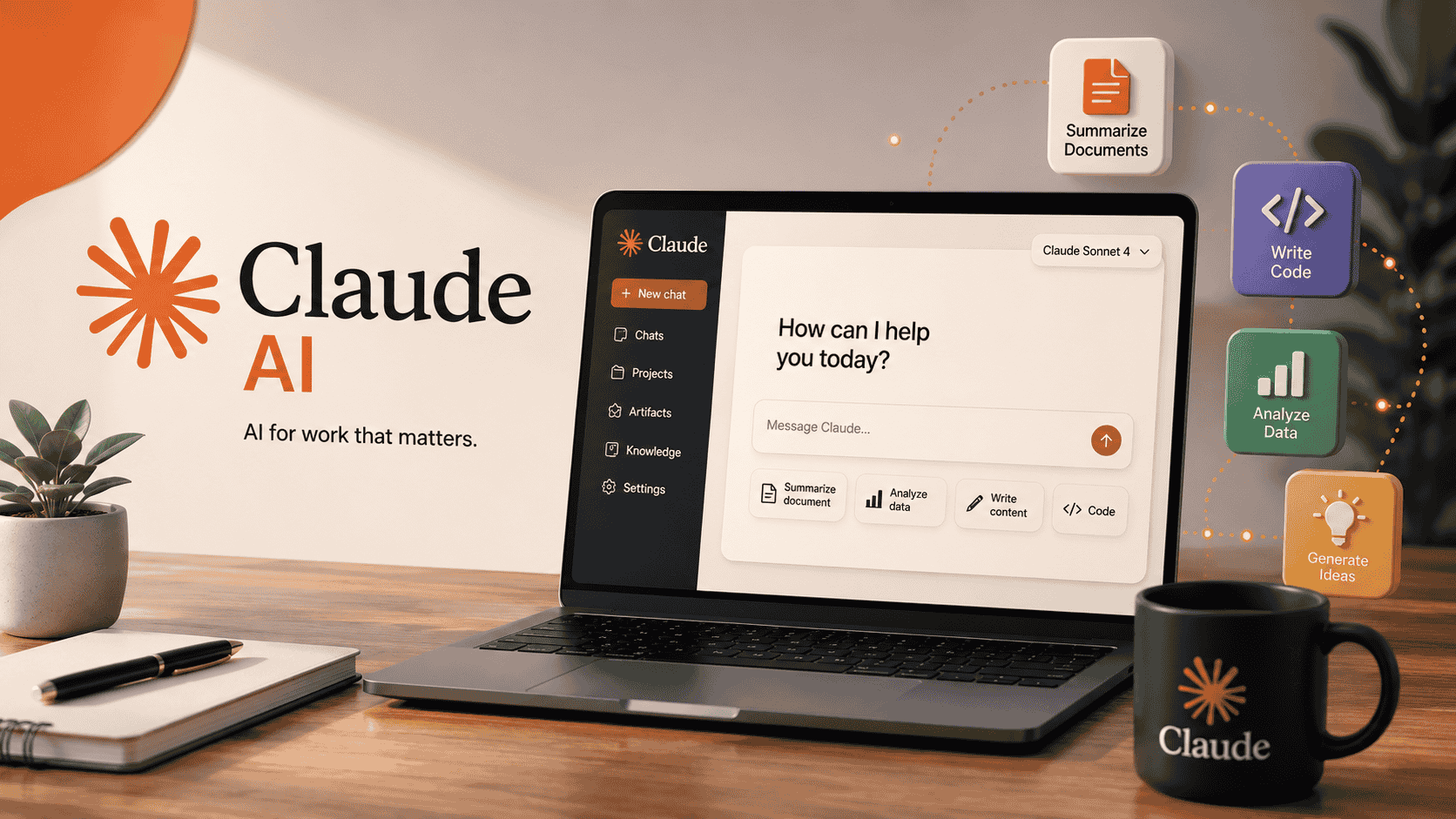
People use Claude for writing and editing, summarizing documents, brainstorming, research, data analysis and software development.
What makes the current generation particularly interesting is its focus on AI agents. Instead of simply responding to one instruction, newer Claude tools are designed to work through multiple steps, use tools and complete more complicated tasks.
Anthropic’s Claude Fable 5, for example, is positioned for demanding knowledge work and coding tasks, while the company continues developing Claude for professional and enterprise workflows.
Why Is Claude AI Becoming So Popular?
The growth of Claude is closely connected to the broader shift toward AI-powered productivity.
People are no longer interested only in asking an AI chatbot a question. They want AI to help them complete actual work.
Claude Code is a good example.
Anthropic describes Claude Code as an agentic coding tool that can understand a codebase, execute routine development tasks, explain complicated code and assist with Git workflows. It is available across terminals, IDEs and other environments.
This makes Claude particularly interesting to developers, but coding is only one part of the story.
Claude AI for Work and Productivity
You do not need to be a programmer to use Claude.
For professionals, Claude can assist with tasks such as:
- Writing and editing documents
- Summarizing long reports
- Brainstorming ideas
- Organizing information
- Research assistance
- Analyzing documents
- Creating business content
- Supporting repetitive workflows
The goal is not necessarily to let AI do everything independently. Instead, Claude can take care of repetitive or time-consuming parts of a task while a person remains responsible for reviewing the final result.
Anthropic’s own 2026 research highlights the expansion of agentic coding beyond engineering teams, including potential applications across sales, marketing, legal and operations.
That broader use of AI could be one of the most important developments to watch.
Claude vs ChatGPT: Which Is Better?
Whenever Claude AI comes up, another question usually follows: Claude vs ChatGPT, which one is better?
There is no universal winner.
Both platforms are evolving quickly, and the better option depends on what you need to accomplish.
Someone looking for a writing assistant may have different priorities from a software developer. A business user may care more about integrations and automation, while a student may prioritize simplicity and accessibility.
Instead of asking which AI is “best,” it makes more sense to compare the tools based on the specific task.
Claude has built a particularly strong identity around writing, reasoning, coding and professional workflows, while ChatGPT has a broader ecosystem of features and integrations. The difference can change as both companies release new models and products.
Claude Code Is Changing AI-Assisted Programming
One of the biggest reasons developers are paying attention to Claude is Claude Code.
Rather than simply generating a piece of code in a chat window, Claude Code can work with an existing codebase and help developers investigate issues, make changes, run development tasks and understand unfamiliar projects.
Anthropic’s current Claude Code offering supports macOS, Linux and Windows and can be used through different development environments.
This represents a larger change in software development: developers are increasingly moving from writing every line manually to giving AI larger objectives and reviewing the resulting work.
That does not eliminate the need for developers. It changes where their time is spent.
Claude AI Is Becoming More Than a Chatbot
The most interesting part of Claude’s development may be the move toward agentic AI.
Traditional chatbots generally wait for a prompt and provide an answer. Agentic systems can plan a task, use available tools and work through several steps.
Anthropic’s current Claude platform includes features around tool use, code execution and managed agents, showing the company’s focus on building systems that can do more than generate text.
This could eventually make AI assistants useful for much more complicated workflows.
Imagine asking an AI to analyze a set of business documents, identify important changes, organize the findings and prepare a report. The value is not just the final text. It is the amount of manual work that can potentially be removed from the process.
Is Claude AI Perfect?
No.
Like other generative AI systems, Claude can make mistakes or misunderstand information. AI-generated content still needs human review, particularly when the information involves financial decisions, legal matters, technical systems or other important areas.
There are also additional risks when AI receives access to tools and systems.
The more independently an AI agent can act, the more important security, permissions and human oversight become.
That is why the future of AI will not only be about making models more capable. It will also involve making them safer and easier to control.
Should You Try Claude AI in 2026?
If you regularly write, research, code or work with large amounts of information, Claude AI is worth exploring.
You do not have to completely replace the tools you already use. Try Claude with a practical task and compare the result with your normal workflow.
For developers, Claude Code offers a particularly interesting way to experiment with AI-assisted programming. For non-technical users, Claude can be useful for writing, analysis, brainstorming and document-based work.
The bigger story is that Claude is evolving alongside the entire AI industry.
The question is no longer simply whether AI can answer a question.
It is whether AI can help complete the work behind the question.
In 2026, Claude AI is one of the platforms pushing that idea forward.