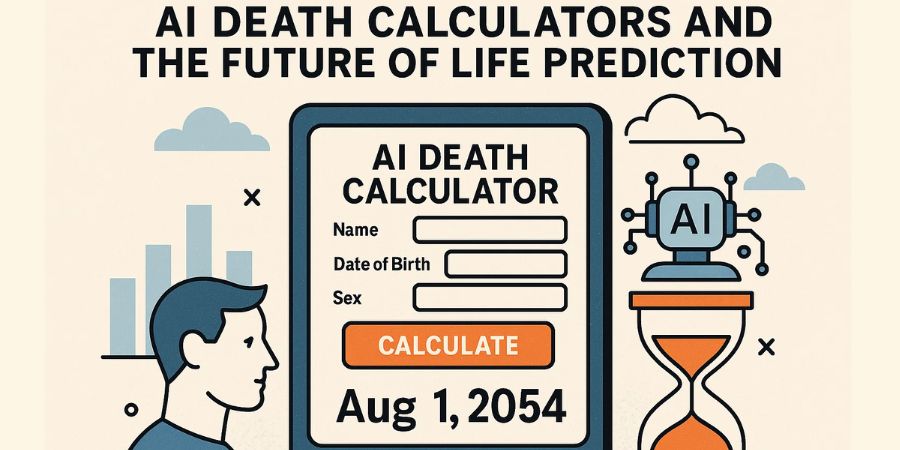
Imagine entering your details into an online form and receiving an estimate of when you might pass away. A recent report suggests an artificial intelligence model reached around 78% accuracy in predicting death within a four year window using rich data from six million people. What this really means is a shift in how we think about mortality, health, data and prediction. The concept of an AI death calculator raises both fascination and concern.
The question is not simply whether such tools can work, but what their existence means for how we view human life, risk and agency. Many people today look at tools like an AI death calculator as a type of life prediction AI, especially when they wonder how AI predicts lifespan or how how AI death calculators work within large datasets. The early discussions around the accuracy of AI mortality predictions show that these systems can help but they also raise questions about the impact of AI on future lifespan estimation.
What is AI Death Calculator and How Does AI Death Calculator Work?
By AI death calculator we mean a tool built on artificial intelligence techniques that uses inputs about your life, health status, lifestyle behaviours, socio economic variables, to estimate your remaining lifespan or even the approximate date of death. One example is the model referred to as Life2vec model, developed with data from the Danish registries. Some people also refer to such systems as life prediction AI or a death prediction tool, especially when the systems appear as simple interfaces online.
According to descriptions, the model treats life events much like words in a sentence and then uses those sequences to infer future outcomes. In effect it imagines your life as a timeline of tokens and makes a prediction. The calculator label tends to be more sensational than accurate, yet the principle is clear: feed the model your life’s details, get its best estimate of how long you will live. People often view this as a version of an AI life expectancy model that highlights correlations at scale, or as part of machine learning life expectancy research that tests long range patterns. As more researchers study the risks of AI based life prediction tools, the public remains curious about what these algorithms can truly see.
How AI Models Predict Life Expectancy
- Researchers collected very large sets of personal data such as hospital records, job history, home movements, education background, income details and health events.
- One major study looked at life event sequences for millions of people in Denmark from 2008 to 2015.
- The model used machine learning methods inspired by Natural Language Processing to map each person’s life path into a complex numerical space.
- After training, the model predicted outcomes like whether a person might live past a certain number of years.
- In one test the system reached about 78 percent accuracy when estimating the chance of death within four years.
- Other life expectancy models use straightforward details such as age, sex, existing illnesses, physical movement, nutrition habits and smoking behaviour.
- A separate study in elder care used an XGBoost machine learning model and reached a C index score of about 0.712 for predicting twelve month survival.
All of this shows that AI mortality prediction tools handle patterns in risk factors very well, especially details that humans understand but cannot analyse at large scale on their own. Some researchers have also used a similar AI life expectancy model to evaluate the impact of AI on future lifespan estimation across different demographic groups.
Strengths of an AI Death Calculator
Scale
- It studies millions of lives at the same time.
- It spots tiny patterns across thousands of variables.
- It handles details that would overwhelm human judgment.
Personalization
- It uses your own details to develop the prediction.
- It gives a clearer estimate than general life expectancy charts.
- It reflects how you live, what habits you follow and your health story.
Insight for better decisions
- It gives a quick look at the biggest risks in your life.
- It helps doctors or care teams act earlier.
- If it catches signs like falling mobility or loneliness, they can step in faster. Tools like an AI death calculator and other life prediction AI systems can highlight silent risk factors. Some health systems even test a machine learning life expectancy pipeline to understand shifts in behaviour.
Innovation in prediction
- It moves from old fixed life charts to flexible systems.
- It keeps adjusting when new information comes in.
- It lets you test simple what if ideas like what may happen if you quit smoking or become more active. Many teams now explore these ideas through updated AI mortality prediction frameworks and upgraded versions of the Life2vec model.
The Limitations and Ethical Issues of an AI Death Calculator
Accuracy Limits
- A prediction accuracy of 78% for death within four years still presents a wide margin of error.
- The model can miss about one in five cases, and the gap may widen when used on different populations.
- The system gives estimates rather than precise dates.
- Many life factors remain outside the model’s reach. These include genetics, sudden accidents, environmental conditions and social support.
- Some early papers now evaluate the accuracy of AI mortality predictions by comparing outputs across regions.
Missing Influences on Lifespan
- Important lifespan drivers link to family income, parental education, childhood surroundings and early life health conditions.
- Many of these influences fall outside a simple model’s input range.
- Data points can barely scratch the surface of the layers of context in which human life is immersed.
Emotional and Psychological Concerns
- Receiving a predicted time of death can create fear or anxiety for some individuals.
- The fact that a person is aware of the new information may lead to a change in the person’s behavior that will produce tension rather than understanding.
- The individuals might start depicting their livings with a restricted period as per the device rather than their own discernment.
Risk of Misuse by Institutions
- If insurers or employers obtain prediction data, they might utilize it for discrimination purposes.
- Life expectancy estimates could lead to unfair practices in hiring, insurance premiums or financial decisions.
- The use of such predictions brings the issues of fairness and individual rights protection to the forefront.
- Many researchers have raised concerns about ethical issues in AI health tools, especially when companies rely on a life prediction AI system for internal decisions.
Data Privacy Challenges
- The use of personal health and lifestyle data in an algorithm ushers in a huge threat to the privacy issue.
- There are multiple situations where confidential information might be revealed, improperly stored or disclosed without the user being fully informed.
- Some digital applications might even attempt to extract personal information or get payment from users by posing as reliable services.
- This is why the risks associated with death prediction tool websites and improper AI death calculator clones remain high.
False Sense of Certainty
- The term calculator can give the impression that the results are predetermined.
- Life, however, continues to be a roller coaster ride depending on one’s ability to bounce back, the people around and luck.
- Relying too much on a machine’s estimate diminishes the area of human influence and the possibility of making choices.
Risk of Fraudulent Services
- Numerous online versions duplicate names from actual research and claim to be reputable.
- The purpose of such tools might be to collect information, display advertisements or even take money from users without providing any reliable or safe data in return.
- Acting as a professional fraud, the prediction of death apps can mislead the user with their tricks.
- Some also misuse phrases like how AI death calculators work or AI mortality prediction accuracy to appear legitimate.
How You Can Respond to the Idea of Your Life Being Predicted
What you can do when you come across an AI death calculator?
- Treat it as one input, not as an absolute truth. If you come across a lifespan that is predicted, treat it as a contemplation thought and not as a final judgment.
- Ask questions: What data underlies the model? What are the conditions? Does it take into account your financial status, character and the people around you?
- Focus on what you can control. Your attention should be directed to what is within your power to control. The forecast may point out the risks areas such as smoking or sedentary lifestyle, but it is up to you to decide whether to take action or not. So use the result to highlight the habits that you can change and monitor your improvement. Tools like a life prediction AI model or a machine learning life expectancy output often highlight patterns that you can adjust.
- Keep your data safe. Always check the app’s privacy policy and what it does with your data, whether it sells or shares it, before providing personal information. Do not visit sites that scare you with disasters or that offer outrageous results.
- Shift the mindset. Do not view the result as a death penalty but rather as a motivation to have a more conscious and careful life. Predicted date is not where the value lies but rather in what it can reveal from you: cleaning up, connecting and engaging in health actions.
This is especially true as the risks of AI based life prediction tools continue to rise, and as misuse grows across unregulated platforms that advertise themselves as a death prediction tool.
Final Thoughts
What this really means is that our relationship with life expectancy and data is changing. Tools like an AI based death calculator challenge the idea that lifespan is unknowable. Yet they also remind us that we remain more than data points. We are relationships, experiences, values and choices. Data can help us see risk. It cannot capture the full richness of a human life.
If we respond with curiosity instead of fear, we might use these tools to enhance our awareness, deepen our relationships, strengthen our health and structure our planning. When we respond with curiosity rather than fear, it is possible that we could take advantage of these tools to improve our awareness, enrich our relationships, boost our health and organize our planning. However we still need to be very aware of the ethical frontiers, privacy matters, limitations of the models and the uncertainty of life.
The most important message that emerges at the end is: regardless of whether the AI estimates seventy years or ninety, the quality of your life during that time is what counts. Take action using information. Use data for contemplation. Make your life count.
You Might Also Like: Yuval Noah Harari Warns: AI Surveillance and the End of Privacy