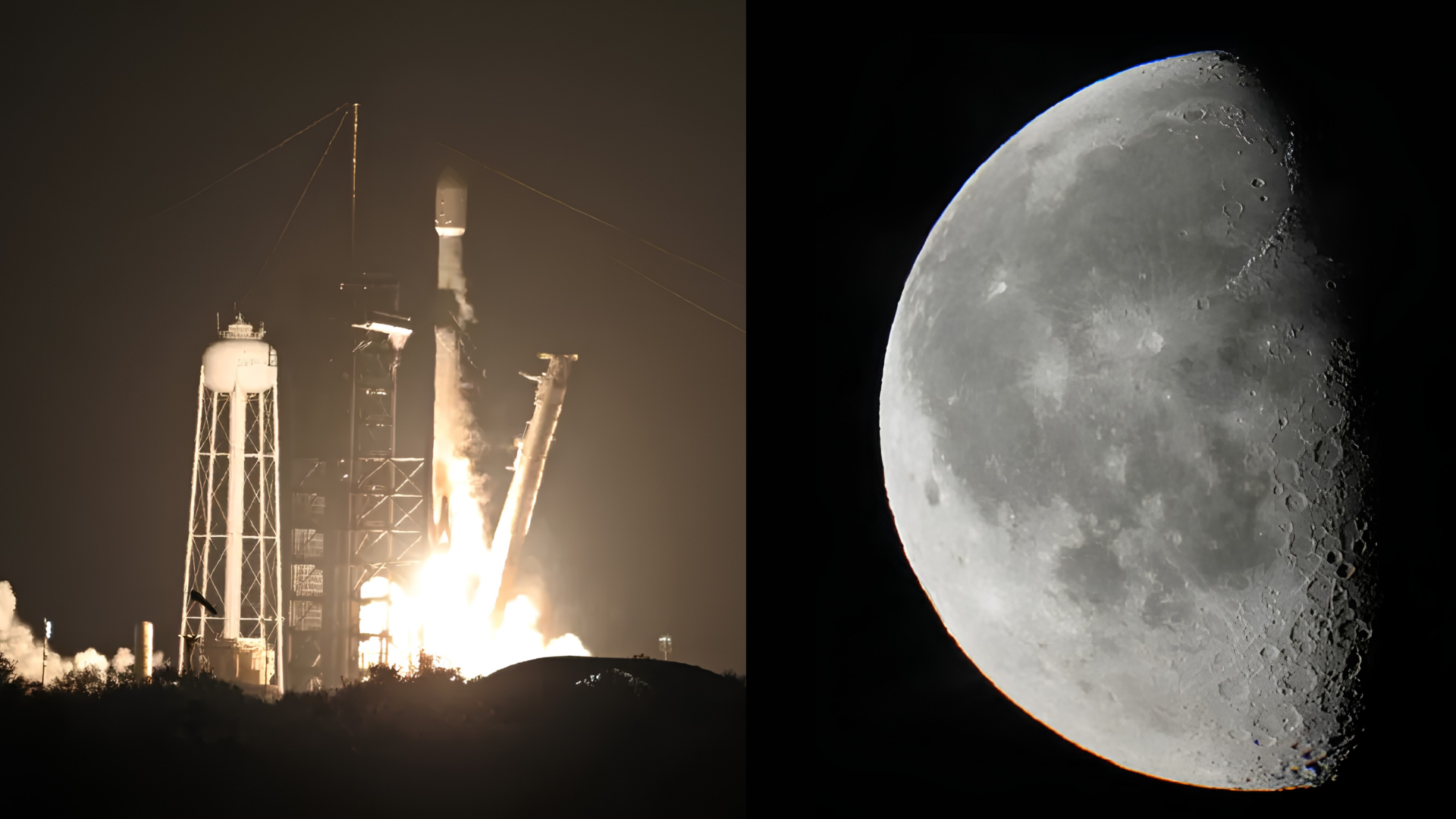
A SpaceX rocket that had been drifting through space for more than a year has finally ended its journey by crashing into the Moon, creating a rare opportunity for scientists to study how high-speed impacts affect the lunar surface. While the event may sound alarming, experts had anticipated the collision and viewed it as a valuable scientific experiment rather than an accident. NASA and astronomers around the world closely monitored the impact, hoping to gather new insights that could support future lunar exploration and deepen our understanding of the Moon’s environment.
The rocket stage involved in the impact was a Falcon 9 upper stage that completed its mission before becoming an inactive object in space. Without enough fuel to return to Earth or maintain a stable orbit, the rocket gradually drifted under the influence of gravitational forces until its trajectory intersected with the Moon. Such events are uncommon, making this collision a significant moment for the scientific community.
NASA had prepared in advance to observe the impact using specialized instruments and telescopes. Scientists expected the collision to produce a cloud of dust and debris, known as an ejecta plume, which could reveal valuable information about the composition of the lunar surface. By studying the material thrown into space during the impact, researchers hoped to identify minerals and elements hidden beneath the Moon’s dusty outer layer.
Initial observations suggested that the impact released traces of sodium and lithium, elements that can help researchers better understand the chemical makeup of the lunar surface. These findings are particularly important because they provide clues about the Moon’s geological history without requiring astronauts or robotic spacecraft to physically collect samples from the crash site. Every new observation adds to the growing body of knowledge that scientists are building in preparation for future human missions to the Moon.
The collision occurred near the Einstein Crater on the Moon’s far side, a region that has long attracted scientific interest due to its unique geological characteristics. Because the far side of the Moon is never directly visible from Earth, studying this area often requires advanced satellites and space-based observations. The impact is expected to have created a fresh crater, giving researchers another feature to analyze using lunar orbiters and future imaging missions.
Although a rocket crashing into the Moon may sound dramatic, experts emphasized that the event poses no danger to Earth or to ongoing lunar exploration missions. The Moon is constantly struck by natural meteoroids traveling at even greater speeds, and its surface is already covered with millions of impact craters formed over billions of years. In comparison, this human-made impact is relatively small, but it offers a controlled opportunity to study the physics of collisions and compare them with naturally occurring impacts.
The event also highlights an increasingly important issue in modern space exploration: space debris. As governments and private companies launch more satellites, spacecraft, and rockets, the number of inactive objects in space continues to grow. While many rocket stages are intentionally directed back toward Earth to burn up safely in the atmosphere, others remain in orbit when fuel limitations or mission profiles prevent a controlled return. Scientists believe that improving long-term planning for spacecraft disposal will become even more critical as lunar missions become more frequent over the coming decade.
Space agencies have already begun developing better strategies to manage orbital debris and reduce the chances of uncontrolled impacts. Missions planned under NASA’s Artemis program and other international lunar initiatives will rely on safer and more sustainable practices to protect future spacecraft and preserve valuable scientific sites on the Moon. Events like this reinforce the importance of responsible space operations as humanity expands its presence beyond Earth.
Beyond the scientific value, the impact has also captured public imagination. Videos, animations, and discussions about the collision quickly spread across social media, sparking curiosity about how rockets travel through space and what happens after their primary missions end. For many people, the event serves as a reminder that space exploration does not end when a spacecraft completes its mission. Even inactive hardware can continue traveling through the solar system for months or years before reaching its final destination.
Researchers will continue analyzing images and data collected before, during, and after the impact to better understand the size of the newly formed crater and the characteristics of the material ejected from the surface. These findings could improve future impact models, assist in planning lunar landings, and help scientists interpret similar craters observed across the Moon.
As interest in lunar exploration grows, every mission and every unexpected event contributes valuable knowledge. The SpaceX rocket’s final encounter with the Moon marks the end of one journey but the beginning of new scientific discoveries that may influence future missions, improve our understanding of planetary surfaces, and support humanity’s long-term return to the Moon.
Stay tuned to Article Basket for the latest updates, breaking space news, and in-depth coverage of the stories shaping the future of space exploration.