When a SaaS company grows fast it gathers momentum and sets up bigger opportunities. According to recent data, 76 % of SaaS firms use SaaS marketing automation tools and those tools deliver around 45 % better lead nurturing results. SaaS growth is more than acquiring users. It requires building a system that converts, retains and expands. As a marketer you will find that focusing solely on new leads misses a large part of the picture.
What this really means is that growth marketing has to be a balanced play: acquisition, activation, retention, referral. Getting this right allows your messaging and SaaS marketing channels investment to work harder. The aim of this post is to walk you through five key strategies in SaaS growth marketing strategies that combine recent research with practical action so you can pick one or two and run with them.
Benefits of SaaS Growth Marketing
Implementing smart SaaS growth marketing strategies delivers multiple advantages:
- Lower acquisition expense: If users are getting a free trial or using the freemium tier, the total cost of acquiring a customer is reduced. For instance, according to the PLG research, 9% of free accounts eventually became paid, and in some segments, the best performers reached a 10% median.
- Faster value delivery: The more quickly a user finds the value of the product, the more likely he/she is to stay. The research indicated improved time-to-value in those companies that have strong self-serve revenue motion.
- Stronger SaaS customer retention and expansion: Keeping clients costs less money than acquiring new ones. If you blend growth marketing with retention and upsell strategies, it results in a stable customer base.
- Data-driven refinement: Growth marketing produces behavioral and usage data which enhances the refinement of messages, funnels and product experience.
- Scalable model: Once you have built and optimized a funnel from acquisition to expansion, it becomes less expensive to bring in new users.
- Scalable model: After you build and optimize a funnel from acquisition to expansion, it becomes more efficient to add users.
Real-world example: A SaaS content marketing tool with a freemium tier welcomes users their way, assisting them with in-app prompts to reach their first goal, then nurturing toward upgrade. This pattern is cheaper than cold outreach and is scalable across users.
Challenges in SaaS Growth Marketing
Designing and executing effective SaaS growth marketing strategies comes with its obstacles:
- Challenge #1 – Aligning product and marketing: When your product is a slow grower and takes days to deliver value, marketing will attract disappointed users. According to PLG research, many companies consider their free model “unintentional” and 40% claim to have slow value delivery.
- Challenge #2 – Pricing and packaging: Pricing optimization was ranked last among the business dimensions by one report. If you create product-led growth flows but SaaS pricing strategy or packaging causes confusion, conversion will be affected negatively.
- Challenge #3 – Balance of acquisition and retention: The old habit of acquiring new customers only still persists among many marketers. However, the data clearly indicate that how to improve SaaS retention and expansion is very important. A market report indicated that the median growth of SaaS companies in October 2024 was approximately 30% with the smallest ones growing at a rate of about 50%, the medium ones on the rate of about 30%, and large companies with more than $20 million ARR growing at a slow rate of about 25%. Scaling has an impact on the speed of SaaS growth, and therefore your strategy must evolve accordingly.
- Challenge #4 – Changing channel landscape: The panorama of SaaS marketing conduits is transforming. A study conducted in 2024 ascertained that email is still the main deliverer of ROI, however, the impact of different channels varies. The growth marketers need to change with the times and not get dependent on obsolete strategies too much.
How to Create a Strategy for SaaS Growth Marketing
Here is a step-by-step approach to build your SaaS growth marketing strategy:
- Step 1 – Map your funnel and metrics: Establishing the key phases of your business as awareness, trial/freemium signup, activation, paid conversion, retention, and expansion/referral. Then state the metrics such as conversion rate from free to paid, time to value, churn, and revenue from expansion. For example, companies that generated self-service revenue scored 25.8% better on the pricing optimization measure, which indicated the how to build a SaaS growth funnel.
- Step 2 – Choose your motion: Whether your business will be driven by a product-led approach, sales leverage, or a hybrid. The data shows that businesses are leaning more towards PLG: up to 91% of companies are going to put more money into PLG.
- Step 3 – Design the activation path: Create a perfect onboarding process that not only provides but also focuses on the early value. Employ in-app prompts, tutorials, and user segmentation in your tools. Fast time-to-value is your goal; it is synonymous with high performance.
- Step 4 – Roll out personalized messages and SaaS marketing automation: Classify users according to their actions and how far they are in the lifecycle. Give them individual email or in-app notifications. Make use of SaaS marketing automation to be ‘human-real’ while communicating at large.
- Step 5 – Improve SaaS customer retention and expansion: Build up the community, give out referral perks, and put user-generated content in place. Keep an eye on churn, activation, and expansion metrics to learn how to improve SaaS retention and expansion
- Step 6 – Continuous testing and optimization: Experiment with different price points, give different kinds of packaging, and cooperate with marketing, and let the distribution be done through SaaS marketing channels. Try the flow and the communication for onboarding in an A/B test. Use the information to constantly improve your funnel and apply SaaS growth marketing best practices.
- Step 7 – Bring the teams together and exchange info: Make certain that the information is disseminated to product marketing, growth, sales, and customer success departments. The usage data creating feedback loops into marketing and product divide the efficiency and SaaS growth.
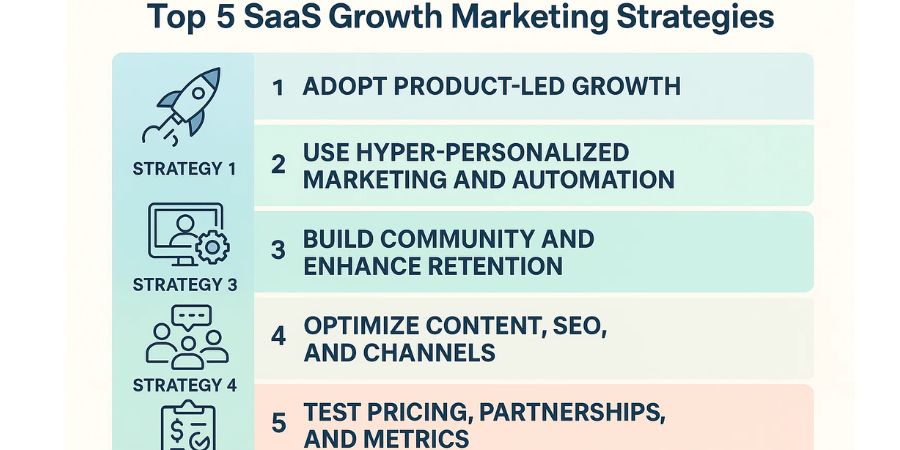
Below are the Top 5 Strategies
Strategy 1 – Adopt Product-Led Growth in SaaS marketing strategies
Product-led growth (PLG) is one of the primary strategies chosen for software as a service (SaaS) companies. The definition is, in fact, that the product is the central tool for gaining, converting, and keeping customers. In this example, you might want to provide a freemium subscription or a low-friction free trial to let people experience your product easily. The studies indicate that PLG is getting to be a primary method for SaaS growth.
Let us look at SaaS product-led growth examples in practice. Suppose you have a B2B SaaS tool for remote teams. A free tier allows up to five users with core features. Users who get value then self-upgrade to paid tiers. Onboarding is smooth, with in-app tutorials and prompts. That makes activation and early value clear. Then SaaS customer retention becomes easier because users already found value.
For your SaaS marketing this means shifting from “we will sell you” to “we will help you get value and you will buy when ready”. This also lowers cost per acquisition because users self-serve. The takeaway: design your product and funnel so the users become your own SaaS user acquisition engine.
Strategy 2 – Use hyper-personalised marketing and automation in SaaS growth marketing strategies
What your users experience today matters. Generic SaaS marketing messages fade. What works better is personalised communication based on behavior, intent and lifecycle stage. According to recent statistics, using SaaS marketing automation and personalised journeys can reduce acquisition cost and improve conversion.
For instance: segment your email list by user behaviour. Then send tailored SaaS content marketing like “You tried feature X - here are three advanced tips to get value.” Use triggers, not just broadcast.
Another part is automation of SaaS lead generation and lead scoring. AI-driven tools now enable you to identify leads likely to convert and serve them high-intent material. The human analogy: imagine a salesperson who remembers each client’s last conversation, knows their challenges and meets them with exactly the right next step. Automation lets you scale that feeling. For your work, pick one behavior to trigger a personalised path each week. Over time those paths compound. That is what profitable SaaS growth marketing strategies look like.
Strategy 3 – Build community and enhance retention in SaaS growth marketing strategies
Acquiring users is only part of the story. Retaining them and turning them into advocates is what fuels sustainable SaaS growth. Studies suggest retaining existing customers costs five times less than acquiring new ones. Community-driven growth serves both retention and referral. You can create a Slack or Discord group for your power users, host monthly webinars, or encourage SaaS content marketing and reviews.
For example, a SaaS marketing firm built a dedicated forum where users posted templates, how-tos and their results. That forum became a source of SaaS lead generation as new users saw peer success and asked to join. Community builds trust faster than growth marketing alone.
Strategy 4 – Optimise content, SEO and channels for SaaS growth marketing strategies
Content and channel strategy still matter. Today your content must serve intent, authority and breadth. SEO remains a strong foundation for SaaS marketing. Map your user’s journey and learn how to build a SaaS growth funnel effectively. Pick keywords relevant to each stage. Create a pillar page on your domain and link sub-topics like customer stories or SaaS product-led growth examples. Also optimise for new visibility surfaces like AI-driven search.
For SaaS marketing channels, treat video short-form content as more than an add-on. It can amplify features, demonstrate value quickly, and drive SaaS user acquisition. The result: more traffic, better leads, and stronger positioning through SaaS growth marketing best practices.
Strategy 5 – Test pricing, partnerships and metrics in SaaS growth marketing strategies
There should be a blend of experimentation and measurement in implementing SaaS growth marketing strategies and SaaS pricing strategy being one of the major elements. By applying hybrid models such as usage-based pricing or feature tier adjustments, the sales conversions can be increased. Partnerships also play an important role: integration partnerships, co-marketing, or referral programs can broaden exposure and trust.
Metrics have become truly significant. Rather than exclusively monitoring leads, track activation rate, SaaS lead generation, churn, and time to value to understand how to increase SaaS conversions. Align marketing, sales, and customer success teams around shared metrics for improved SaaS growth.
Tools to Use for SaaS Growth Marketing
The following tools are seen in effective top SaaS growth marketing strategies for startups:
- Product analytics: Mixpanel, Amplitude and other similar tools are capable of monitoring customer activities, time-to-value, and activation milestones.
- Marketing automation: HubSpot, Marketo, and Customer.io are helpful in messaging, triggers activation, and user nurturing through the SaaS marketing funnel.
- Onboarding & in-app messaging: Pendo, Userpilot, and analogous applications aid in onboarding and retaining SaaS users throughout the user acquisition and retention journey. Community & referral platforms: Slack, Discourse, and ReferralCandy assist in content marketing for SaaS companies and managing their communities.
- Community & referral platforms: Slack, Discourse, and ReferralCandy support SaaS content marketing and community management.
- Pricing experimentation software: Price Intelligently and ProfitWell are examples of the best SaaS marketing tools 2025 for testing pricing models.
Conclusion
For the implementation of the above-mentioned SaaS growth marketing strategies, a change in thinking is required. SaaS growth can no longer be seen as an ad budget issue. It is about creating the product and experience with value, personalization, community building, and continual testing.
Choose two of the five top SaaS growth marketing strategies for startups this quarter and focus with intention. You could start with PLG and community building. Keep track of activation and retention rates and then move to automation and content optimization. The power of product-led growth resides in investing in what users value most. With clarity and intentionality, these SaaS growth marketing best practices will show you how to increase SaaS conversions and drive long-term success.