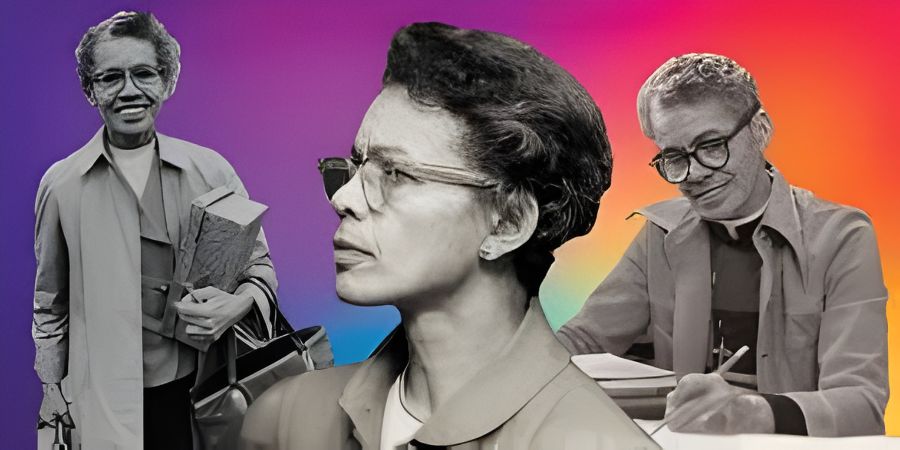
Pauli Murray lived a life that defied every label society tried to give her. She was a lawyer, poet, priest, activist, and intellectual who spent her entire life challenging systems that divided people by race and gender. Long before terms like “intersectionality” entered the public conversation, Pauli Murray was already living its reality. She fought racial segregation, questioned gender norms, and helped form the legal arguments that would later advance both the civil rights and women’s rights movement.
Yet, for decades, her name remained in the background of history, her influence overshadowed by those she inspired. Pauli Murray biography is not only about resistance but also about vision, the ability to see fairness as something that had to be built, word by word and law by law. To understand her journey is to understand how courage and intellect can reform an entire nation’s sense of justice.
Early life and family roots of Pauli Murray
Pauli Murray was born Anna Pauline Murray on November 20, 1910 in Baltimore, Maryland. Her background was complex. Both her parents identified as Black, yet their ancestry included enslaved and free Black people, white slave-owners, Indigenous Americans and Irish immigrants, Pauli Murray described the family as a “United Nations in miniature.” When she was only three her mother died of a cerebral haemorrhage; her father later suffered serious illness, and Murray went to live with her maternal grandparents and aunt in Durham, North Carolina.
Growing up in the segregated South shaped her perspective early on. Her family taught her about their mixed heritage, and she absorbed lessons on dignity and self-worth even as the world around her treated her as second class. By age five she taught herself to read, and by her mid-teens she had already graduated high school at 15.
What this really means is that from the start Pauli Murray life story was not simply reacting to injustice. She carried within her the weight of legacy, her ancestors’ struggles, and her own sense of being between multiple worlds. That inner tension became fuel for the life she would lead.
Education and embracing civil-rights activism
Pauli Murray moved to New York City and studied at Hunter College, graduating in 1933 with a degree in English literature. She worked through the Great Depression, taught remedial reading, and wrote for magazines. She lived with the tangible reality of both racial and gender barriers. When she applied to the University of North Carolina in 1938 she was rejected because of her race.
In 1940 Pauli Murray was arrested in Virginia after refusing to sit in the back of a bus. That incident deepened her commitment to challenge segregation directly. She enrolled at Howard University School of Law, becoming the only woman in her class and graduating first in 1944.
What matters in this phase is that Pauli Murray civil rights work did not wait for permission. She seized educative opportunity, faced systemic barriers head-on, and turned those challenges into activism. She began to articulate ideas about race and gender that were ahead of her time.
Legal scholarship and key contributions to equality
Pauli Murray contributions to equality built bridges. After Howard she earned a Master of Laws at Berkeley and in 1965 became the first African-American to receive a J.S.D. (Doctor of Juridical Science) from Yale. In 1950 her work States’ Laws on Race and Color was called the “bible” of the civil rights movement by Thurgood Marshall.
Pauli Murray, an African American lawyer, coined the term “Jane Crow” to describe how sexism and racial discrimination intersect for Black women. She influenced the landmark 1971 Supreme Court case Reed v. Reed; Ruth Bader Ginsburg influence acknowledged Pauli Murray’s ideas as foundational.
Here is a concrete example. When lawyers argued that women were protected by the Equal Protection Clause, they drew on Pauli Murray influence on women’s rights, reasoning that discrimination based on sex mirrored discrimination based on race. Pauli Murray impact on civil rights law quietly changed the law and shifted the terrain so rights that seemed distant became accessible. What this means is that her ideas redefined the boundaries of justice.
Faith, identity and the later years
In her later years Pauli Murray turned from law and activism into faith-based service. In 1977 she became one of the first women ordained in the Episcopal Church priest and the Pauli Murray first African American woman priest in that body. She served in ministry to the sick and the marginalized until her retirement.
Pauli Murray and gender identity reveal how she lived with complex questions around gender and sexuality. She adopted the name “Pauli” and explored how her own identity did not fit conventional categories. Though she rarely made that private struggle public in her lifetime, historians now recognise it as part of her journey.
In 1985 Pauli Murray, the intersectionality pioneer, died of pancreatic cancer in Pittsburgh. The takeaway here is that she refused to stay in one lane. She moved from scholar to lawyer to preacher, from public protest to spiritual service; she blurred the lines that others insisted should stay rigid. That capacity to adapt and to keep questioning mattered.
Legacy of Pauli Murray and what this really means
Pauli Murray legacy is still unfolding. Her name now graces one of Yale’s residential colleges, marking Pauli Murray legacy at Yale, and she is increasingly recognised in history books, civic memory and film. For activists, lawyers and scholars, she remains a sign-post that change happens when you connect ideas, identity and action.
One clear takeaway: when you see injustice, respond not just in the moment but build the intellectual tools that make change durable. Pauli Murray impact on civil rights law and Pauli Murray contributions to equality did that. When you feel different or out of place, remember that such spaces can become vantage points for insight and innovation. And finally: legacy does not require limelight. Pauli Murray influence on women’s rights shaped foundational legal precedents without always being in front of the camera.
If you walk away with one thought it is this: who was Pauli Murray reminds us to bridge divides, race and gender, scholarship and service, identity and purpose. That kind of bridge-building remains urgent now, and Pauli Murray’s biography continues to guide the American civil rights activist and women’s rights movement toward a fairer society. Pauli Murray civil rights vision stands as the ultimate example of what it means to live with purpose as an intersectionality pioneer and an African American lawyer whose legacy still shapes equality today.