Artificial intelligence is evolving from just giving fixed answers to actually solving complex problems in the real world. A major hurdle has been the way AI agents interact with tools and live data in a secure and reliable manner. Now, Google’s Managed MCP Servers are addressing this issue globally. This write-up elaborates on their nature, operation, and importance for developers and companies.
What is the Model Context Protocol (MCP)
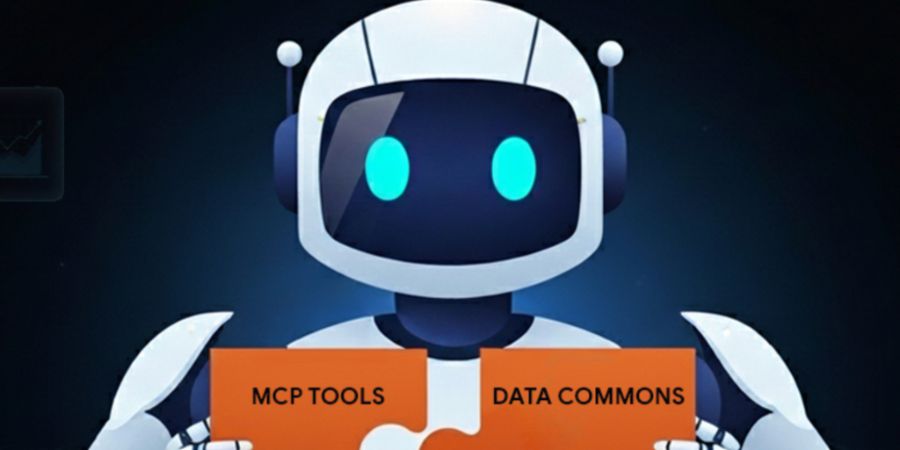
Before fiddling with Google’s managed servers, one must have a fair idea regarding what MCP is. Model Context Protocol is what MCP stands for. It is an open standard that defines the manner in which AI models and agents should interact with the outside world i.e. databases, APIs, or cloud services, via a standard interface.
If you picture MCP as a universal connector for AI agents, that’s exactly how USB-C became a standard connector for hardware. Anthropic created MCP and made it available to the public in late 2024. A couple of days after its debut, a lot of AI platforms which included Google started to implement the standard that was being defined by them for how agents get access to tools and data.
It was created so agents can ask for specific capabilities or services and receive responses without manual integration coding. Google’s managed MCP servers wrap this protocol around its own products, enabling agents to interact directly with services like Maps or BigQuery.
Instead of learning static data or relying on approximations, AI agents can now access up-to-date information from real services. For example, an analytics assistant might query BigQuery data directly to answer questions about sales performance. A travel planning agent could use Maps data in real time rather than guessing from cached knowledge.
New Infrastructure for AI Agents
Google has come with a new strategy to enable AI agents to easily access its cloud and data services that are grouped as a suite. These are new means called managed MCP servers, which by simple means show how AI systems can get in touch with such complex services as Google Maps, BigQuery, Compute Engine, and Kubernetes Engine.
The aim of managed MCP servers is one that can be easily understood. AI agents were limited by the problem of how to connect to the real-world tools and data sources. It used to be the case that developers had to create custom connectors, which could take several days or weeks to be ready. Managed MCP servers do away with most of the work by providing AI systems with plug-and-play endpoints which are already there.
How This Changes Development
Previously companies had to spend serious engineering resources to knit together AI logic and backend tools. With Google’s managed MCP servers, developers can copy a server URL into their agent and go. That reduces friction, oversight issues, and the governance headaches that come with custom connectors.
Google Cloud’s product teams believe this will usher in a new era for enterprise AI. Instead of isolated experiments, businesses can build agents that talk directly to important infrastructure systems. That includes analytics tools, cloud compute resources, and container orchestration systems.
Public Preview and Future Plans
At launch, managed MCP servers are available in public preview, meaning they are accessible for enterprise customers but not yet covered under full service terms. Google plans to expand the lineup of supported services over time, eventually bringing in storage, databases, logging, security tools, and more.
This preview period allows companies to experiment and provide feedback. It also gives Google time to polish the technology before a broader rollout. The managed servers are offered at no additional cost to existing enterprise customers, a move that may encourage more organizations to try them sooner.
Security and Control
Google is gating these MCP endpoints with Cloud Identity and Access Management (IAM) controls rather than treating them as completely open highways. What this essentially means is that, through the use of such controls, administrators are empowered to define the capabilities of an AI agent with respect to a specific service. Additionally, the configuration is equipped with security measures like firewall protection and audit logging to follow agent activity.
With the emphasis on security, Google is willing to put AI agents at the disposal of business scenarios, which are very sensitive in nature. In such a manner, agents are allowed to carry out their functions without the exposure of the underlying data or the infrastructure to the unnecessary risks.
Impact on the AI Ecosystem
Google’s move towards managed MCP servers for AI shows an understanding of the change in the way AI systems are constructed. Such systems are not simply text tools but are rather, active agents that can take actions and make decisions. Google wants to speed up that change by reducing the technical challenges for integration and thus, reaching out to more companies to make AI agents working in the real world a feasible solution.