It is very important to have whistleblower protection at this time. The latest studies indicate that almost 60% of people who reveal the misconduct of others at work, are subjected to some form of retaliation at work.
During the year of the pandemic, in the United States only, a number of federal agencies such as OSHA, have registered the highest levels of complaints about retaliation at work.
On the other hand, the internal reporting channels are still weak or mistrusted, for instance, more than half of employees declare that the reason for which they do not make use of hotlines is the fear of reprisals.
The situation poses a direct question: how can people who put everything at risk to tell the truth feel safe? Proper whistleblower protection is not only a legal requirement. It represents a basic instrument for employee protection. However, when these protections fail, people become the ones who suffer the most, and the whole systems lose their stability.
What is Whistleblower Protection?
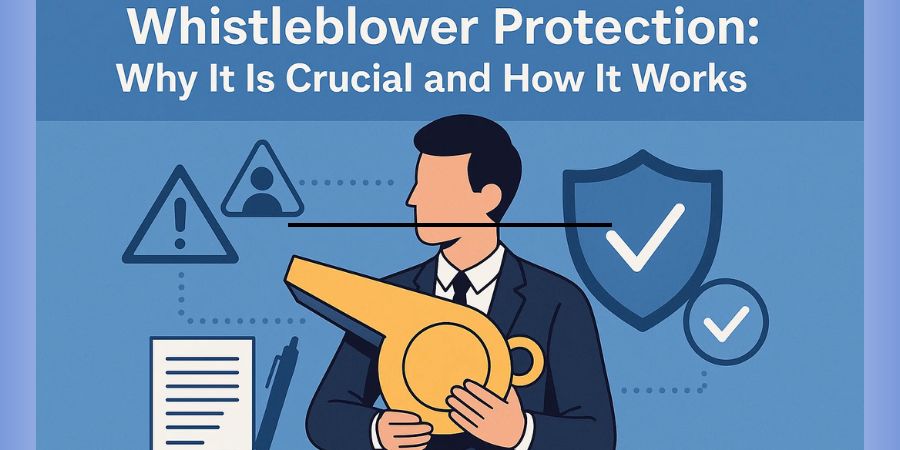
Whistleblower protection is the set of whistleblower laws and measures put in place to protect people who reveal the wrongdoings, illegal actions, or threats caused by someone’s behavior within an organization.
A whistleblower is a person who reveals wrongdoings such as falsifying records, bribery, violating safety rules or misuse of power to internal reporting channels, regulatory bodies, or even the press. Fundamentally, the protection is about guaranteeing that the brave one does not go through the adverse consequences such as being terminated, demoted, or harassed.
Why Whistleblower Protection Matters
Usually, whistleblowers are the people who suffer most from the injustice they expose, thus they are on the frontline in the fight against it. Globally, the median percentage of those who retaliate against employees after reporting misconduct is 61%. So, numerous possible whistleblowers prefer to keep quiet if there are no firm legal safeguards.
Survey results show that the feeling of fear greatly prevents people from taking such a step. In one of the studies, more than half of the workers thought that they would be punished if they decided to raise their voice. The cost of such an unethical practice which is not only a moral issue but can also be financial and professional costs, is what happens when wrongdoers are allowed to operate freely.
Real‑World Risks for Whistleblowers
However, it is a fact that a whistleblower is not totally out of danger, and one should expect the worst if he decides to blow the whistle. Studies that have been carried out in different countries reveal that most of these people have been attacked, demoted, or dismissed after reporting misconduct.
- Mental health risks for whistleblowers: Whistleblowers are usually subjected to such extreme stress, isolation, and stigma that these factors become a serious problem for their mental health. The results of the studies demonstrate that a significant number of them suffer clinical levels of anxiety and depression, have difficulty in sleeping, and are ever more distrustful. There are also cases when the company uses the organization’s stigma on mental health as a weapon: there are several reports of firms discrediting whistleblowers by giving them the labels of being too emotional and mentally unstable.
- Financial and professional costs: The disclosure of wrongdoing may exhaust a person’s financial resources. In the case of interviews, people have testified that they have expended anywhere from tens of thousands to more than one hundred thousand dollars on legal fees only. Besides that, many people lose their jobs and are not promoted; some of them are transferred to positions in which they perform tasks that have no value.
- Physical and Health Costs: The situation is also accompanied by some health problems. According to the data, whistleblowers’ annual health-care costs (both mental and physical) may increase because of stress, which can be accompanied by increased medical bills and, in some cases, health insurance loss.
- Retaliation at work: Retaliation is very diverse in its manifestations: for example, it can be reflected in negative performance reviews, verbal abuse, or exclusion from social activities by colleagues. Certain individuals are subjected to harsher forms of retaliation: for instance, female whistleblowers have mentioned that they are more likely to be intimidated, receive negative evaluations, or have their careers sabotaged.
- Legal and Reputation Risks: Whistleblower rights are not always enough to prevent unfair termination, but it happens in some of the most extreme cases in real life. To illustrate, Eileen Foster was let go from her position due to the exposure of financial fraud at her company. After that, some people will be on the industry’s blacklist and will find it difficult to get a job even though they have been through the legal process.
- Threats to Personal Safety: In the unfortunate and dangerous cases, whistleblowers may have to deal with the loss of their lives. As a shocking example, after Babita Deokaran, a South African civil servant, blow the whistle on procurement corruption, she was shot outside her home.
It points out the risks that are at the very core of why the whistleblower protection is not simply legally regulated. To put it simply, for a person who decides to speak up, the consequences may affect him personally in terms of mental health risks for whistleblowers, money, reputation, and even safety.
Legal Frameworks for Whistleblower Protection
Different jurisdictions handle protection in different ways.
- United States: A Patchwork of Federal Protections: Whistleblower protection in the U.S. is a result of various whistleblower laws. The False Claims Act allows whistleblowers to bring “qui tam” lawsuits on the government’s behalf. In addition, there are workplace‑specific protections under certain acts like Sarbanes‑Oxley (SOX), which is a protective measure for employees who expose financial fraud. For the personnel involved in national security or intelligence, Presidential Policy Directive 19 is the one that assures the absence of retaliation at work when reporting misconduct classified waste or abuse. Apart from that, there are also some unique or specialized protections, for instance, the Criminal Antitrust Anti‑Retaliation Act, which provides employee protection to individuals, who disclose the violations of U.S. antitrust laws.
- In the European Union, a landmark law called Directive (EU) 2019/1937 or the “Whistleblower Directive” establishes the minimum whistleblower protection standards which all the member states should provide. According to this directive, any public or private entity (especially those having 50 or more employees) is required to have secure reporting channels for whistleblowers. The member states are supposed to enact their own national whistleblower laws that are in line with the directive’s core requirements: protection from retaliation at work, confidentiality for the whistleblower, and follow‑up investigations.
Different countries within the EU have taken different paths:
- Germany put into effect its Hinweisgeberschutzgesetz in the middle of 2023, which is a law that demands companies of a certain size to have internal reporting channels.
- France changed its laws through the “Waserman Law,” thus strengthening the whistleblower protection provided by the already existing Sapin II framework.
- The new law on whistleblowers in Spain (Law 2/2023) is not only a piece of legislation that requires internal reporting channels but also that an independent external authority be in charge of receiving and managing the complaints of whistleblowers.
- Sweden passed a law in 2021 that, among other things, allows anonymous reporting and grants the whistleblower protection from both civil and criminal liability.
Global Norms and Other Countries
Outside the U.S. and EU, whistleblower laws can be found in different parts of the world; however, their strength and coverage differ. As per the OECD study, some countries have developed separate, comprehensive whistleblower protection laws in the US and EU that cover both the public and private sectors (e.g., Ireland, Hungary, South Africa, New Zealand). On the other hand, some countries have only sectoral or piecemeal legal provisions for their employee protection.
For instance, in Australia, the situation is a combination of laws at both federal and state levels. The whistleblower protection is provided in some instances, but the implementation is not consistent in all sectors.
International Standards
One of the fundamental roles the United Nations Convention Against Corruption (UNCAC) has is to be the main reference worldwide for the idea that countries ought to ensure the safety of whistleblowers who are not to be victims of retaliation at work.
According to the National Whistleblower Center, legal experts and international organizations, such as the IBA, are of the same opinion that domestic legislation should not only reflect the best practices in its provisions but also in the actual implementation.
What This Really Means
Different jurisdictions worldwide are improving legal structures to protect whistleblowers; however, a perfect model applicable globally does not exist. Specialized whistleblower laws form a patchwork in the U.S. The EU harmonizes the situation to some extent through its directive, but the implementation of each country differs.
Several other countries are in the process of establishing their frameworks or have partial protections only. The main difficulty is not just drafting strong laws but also ensuring that they function effectively in practice: internal reporting channels should be the most trusted and be of a high standard, and authorities should be willing to protect whistleblowers when they seek help.
In addition, the U.S. has the idea of a qui tam lawsuit: according to the False Claims Act, a whistleblower can file a suit in the name of the government and get some of the money if there is a settlement or a court award.
How Protection Helps Societies and Organizations
The whistleblower protection given to whistleblowers is one of the main reasons why the exposure of the fraud happens at an early stage. As an example, consider the case of the financial fraud: it was whistleblowers in the SEC (Securities and Exchange Commission) programs that lit the fires leading to the investigations from which billions of dollars were recovered. In addition, these systems motivate people to reporting misconduct because there are some benefits, for example, under the SEC program, quite a few whistleblowers get a generous financial award.
Inside a company, an environment of strong whistleblower protection can increase the organizational transparency. When people understand that they can afford to raise their concerns, moral problems most probably will come to the surface. That stops the use of the system and usually helps to strengthen the compliance culture: firms that have a real whistleblower policy are less likely to experience reporting misconduct cases.
Challenges in Effective Whistleblower Protection
Even with whistleblower laws in place, protection is still not very close to being assured. Enforcement is a big issue. It is one thing to have a law; it is a whole different thing to make sure that the internal reporting channels are independent, trusted, and effective. A number of organizations do not have formal policies, and some consider whistle‑blowing just as a human‑resources issue, thus, not recognizing it as a compliance culture risk.
Another issue that is faced is the stigma. Whistleblower rights are, in most cases, led to believe that they are alone. In one report, more than half of the people who came forward said that they felt isolated. That feeling of being left out is due to, on the one hand, pressure from the people surrounding the whistleblower, and on the other hand, the absence of support networks. In a lot of places, the financial and professional costs of the law and the personal suffering that come with the consequences of retaliation against whistleblowers are too high.
Lastly, there is the issue of different standards worldwide. Some countries have good whistleblower laws, and some are still developing them. Even though enforcement varies, with the existence of systems, there is a possibility that internal reporting channels are not trusted. Research that developed a “how whistleblower protection works” index concluded that providing legal safeguards is only one part of the solution, what really matters is how seriously the consequences of retaliation against whistleblowers are taken, how much real evidence is collected, and whether reporters feel secure.
Steps to Strengthen Whistleblower Protection
- Build a Trust-Based Culture: Make it a culture that going against the flow or calling out wrongdoings is supported and trusted. Whistleblowing has to be led by the CEO and top management especially the leaders. Their open support is a sign that concern raising is safe, allowed, and appreciated.
- Establish Clear, Accessible Secure Reporting Channels for Whistleblowers: Ensure that there are as many as possible and secure methods of reporting misconduct, e.g., anonymous hotlines, digital platforms, and in-person options. These communication channels ought to be user-friendly and their confidentiality should always be guaranteed.
- Train Employees Across the Board: Periodic training enlightens the people about what kinds of misbehavior are there, how to reporting misconduct, and what whistleblower rights are there for the reporters. Scenario-based exercises should be included so that employees can apply the policy to the real-world scenarios.
- Ensure Transparency in Investigation Processes: Be certain of fairness, promptness, and clear structuring of the investigation in the case of the report made by someone. Create timelines for the investigations and keep records of every step. Talk to the informer about the progress without giving away confidentiality.
- Set Up Independent Oversight: Employ an independent body (or a third party) to be in charge of receiving the reports and overseeing the investigations. This lessens the chance of a conflict of interest and raises the level of trust. Among other things, Transparency International also suggests self-assessment frameworks so that organizations can evaluate the effectiveness of their system.
- Raise Awareness Continuously: Communication campaigns can be used to create awareness: newsletters, posters, and regular talks are some of the means to inform people that they will be supported and it’s safe to reporting misconduct. Success stories should be promoted while the identity of the person is kept so that others get to see the actual instances of change.
- Provide Support for Whistleblowers: Offer them legal safeguards, psychological counseling, and financial support. A lot of the time when they do so, whistleblowers have to bear the risk of the loss of their emotional, financial and professional costs, thus support lessens these costs and more people will be encouraged to come out.
- Use Technology Thoughtfully: That can be done by the help of technology which is secure and reliable: encrypted platforms, mobile apps, and forms that can be submitted remotely.
- Monitor, Evaluate, and Improve: The efficacy of the whistleblower protection system needs to be checked on a regular basis. The self-assessment internal reporting channels tool by Transparency International can be utilized to discover weak points. Getting feedback from the users of the system and using the real data (such as how many reports are made and how many are acted upon) to fine-tune the policy.
- Strengthen Legal Protections: There should be well-rounded legislation from governments or regulatory bodies that provide employee protection not only to staff but also to contractors and third parties who blow the whistle, plus cases of different types of retaliation at work should be preventive. Punitive measures must be taken against those enterprises that retaliate.
Conclusion
Whistleblower protection should not be considered as a luxury. It is the basis of accountability in both public and private institutions. When it is done properly, it gives people the power to speak out, stops the occurrence of harm, and, in addition, raises the standard of workplace ethics in organizations. However, whistleblower laws alone do not solve everything.
The real work is all about creating trust, carrying out the whistleblower rights, and assisting those who take the risk of telling the truth. Whistleblowers will be in a vulnerable position and misconduct will be concealed if there is no such thing. If we are concerned about justice and organizational transparency, then we need to put our money into the establishment of the importance of whistleblower protection in organizations and the steps to strengthen whistleblower protection for those who dare to blow the whistle.
How whistleblower protection works is key to creating a safe, ethical, and transparent workplace.
You might also like: 10 Leading Entertainment Tools You Need to Know