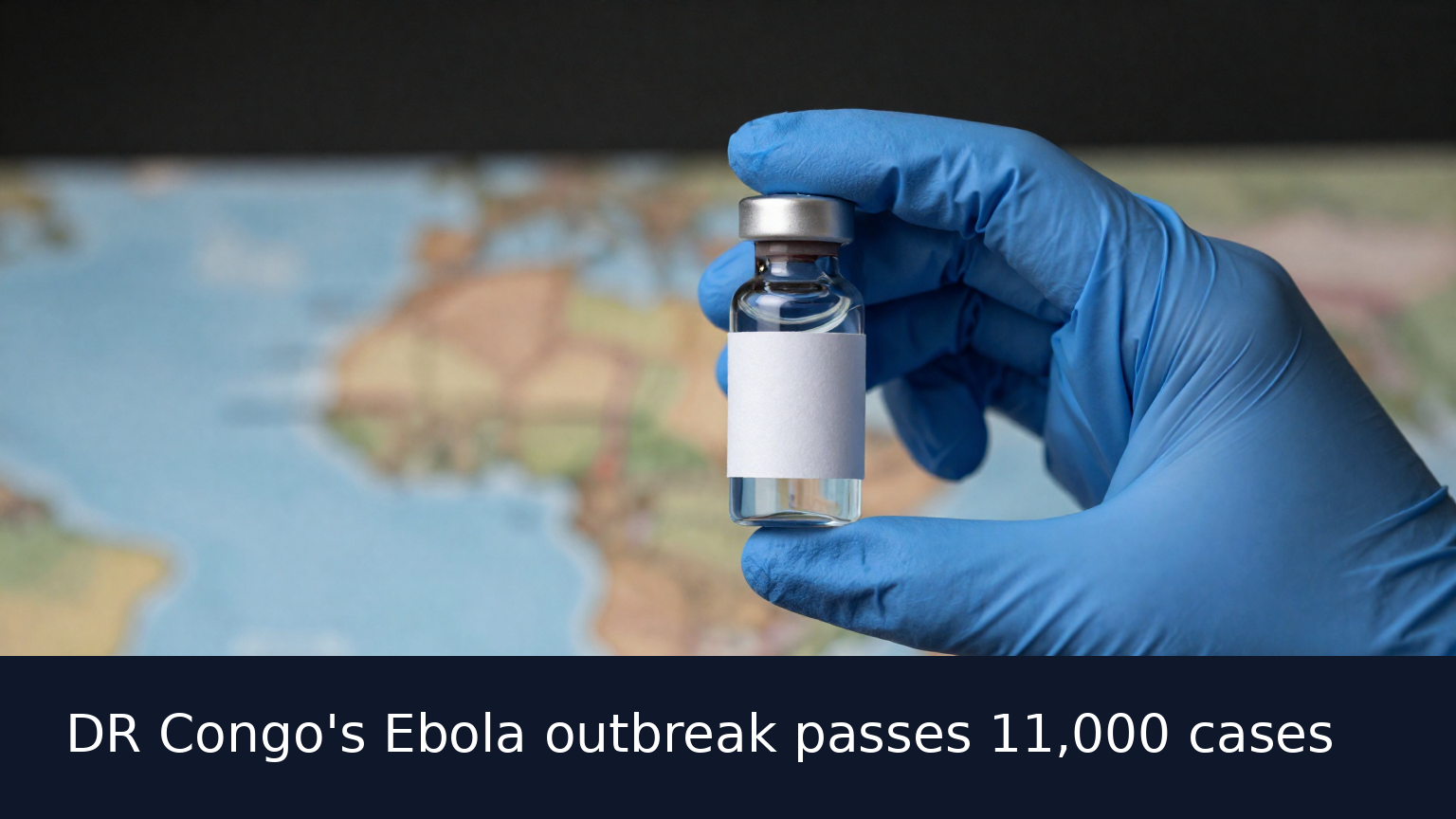
The Ebola outbreak in the Democratic Republic of the Congo has passed 11,000 confirmed cases, according to government data released on Tuesday, making it the largest and deadliest Ebola outbreak in the country’s history. The figures, 11,042 confirmed cases and at least 5,387 deaths, were carried by Al Jazeera and Reuters on 11 November. [1]
It is now the second-largest Ebola outbreak ever recorded, behind only the 2014 to 2016 West African epidemic, which infected more than 28,600 people and killed more than 11,000. [1] Here is what the numbers show, and why this one has been so hard to stop.
What do the latest figures show?
The World Health Organization’s most recent bulletin, published on 6 November with data to 3 November, put confirmed cases at 10,668, including 5,198 deaths and 2,881 recoveries, a crude case fatality ratio of 48.7 per cent. [2] The Congolese government data released days later pushed the totals past 11,000 cases and 5,387 deaths. [1]
Cases have been confirmed in 67 health zones across eight of the DRC’s 26 provinces, and 51 of those zones reported new cases in the most recent 21-day period. Ituri province is the worst affected, with 7,485 confirmed cases and 3,532 deaths, followed by Nord Kivu, where the fatality ratio is running at 54.8 per cent. [2]
Why has this outbreak been so hard to contain?
Three factors keep coming up in the official assessments: delayed detection, conflict and strained health services. [1] Many deaths are happening in communities rather than treatment centres, especially among young children, which points to cases being found too late. Of the 512 deaths reported in one recent two-week window, 335 occurred outside treatment facilities. [2]
Contact tracing is also behind target. Health workers aim to check on 95 per cent of known contacts every day; the average across the affected provinces was 86 per cent, and in Nord Kivu only 82 per cent. [2] Every missed contact is a chance for the virus to move unseen.
Insecurity is making that worse. The WHO’s director-general told member states on 11 November that attacks on health workers and communities have become one of the greatest obstacles to ending the outbreak: an attack on the town of Cantine-Aloya last week killed 66 civilians, including three health workers, three health facilities were looted and burned, and more than 1,000 contacts were lost to follow-up. [4]
What is different about this strain?
The outbreak is caused by the Bundibugyo virus, one of the rarer strains of Ebola, and it kills about half of the people it infects. Crucially, no vaccine or treatment has been developed specifically for this strain. [1]
There is some movement on that front. Earlier this month, the WHO approved clinical trials of two new Ebola vaccines, with results expected in early 2027. [1] Until then, containment relies on the older tools: finding cases fast, isolating them, tracing contacts and safe burials.
How far has it spread?
The outbreak was declared on 15 May 2026. Since then, cases have been reported in five countries: the DRC, Kenya, Nigeria, Uganda and France. [2] The outbreaks in Uganda and France have been controlled since August. Kenya has recorded nine cases and two deaths, all linked to one imported case and one cluster, with no new confirmed cases since 19 October; the WHO said on 11 November that Kenya’s last patient has been discharged and the country has begun its 42-day countdown to declaring the outbreak over. Nigeria reported a single imported case in Abuja in October, who was medically evacuated to Switzerland. [2][3][4]
Two countries have evacuated infected citizens for treatment: Switzerland, and the United Kingdom, which flew a health and care worker to London on 5 November. [2] Al Jazeera notes that cases reported across East, Central and West Africa give this outbreak the widest geographic spread of any Ebola outbreak on the continent to date. [1]
Should other countries be worried?
The WHO currently advises against any restrictions on travel to, or trade with, the countries responding to the outbreak. [2] The European Centre for Disease Prevention and Control assessed in October that the likelihood of infection for people living in Europe is very low, while stressing cross-border surveillance and preparedness in the region. [3]
The realistic concern is not a global spread but a regional one: sustained transmission in the DRC means neighbouring countries need readiness at points of entry, fast case detection and coordinated response plans. [2]
Final takeaways
Ebola in the DRC has passed 11,000 confirmed cases and 5,387 deaths, the country’s largest outbreak on record and the second largest ever. The Bundibugyo strain has no specific vaccine, contact tracing is below target in the worst-hit provinces, and most deaths are happening outside treatment centres. The outbreak is not under control, but it is also not, at this stage, assessed as a significant risk beyond the region. The WHO’s director-general said on 11 November there are encouraging signs that transmission is slowing in some areas and almost 3,000 people have recovered, while warning that new hotspots continue to emerge and the outbreak remains a public health emergency of international concern. [4] The numbers to watch are the weekly case counts in Ituri and Nord Kivu, and whether the vaccine trials now approved deliver results next year.
Sources
Checked 12 November 2026. Outbreak figures change daily; the sources below carry the dates their data was recorded.
- Al Jazeera and Reuters, 11 November 2026, Ebola cases in DR Congo pass 11,000, with 5,387 deaths: https://www.aljazeera.com/news/2026/11/11/ebola-cases-in-dr-congo-pass-11000-with-5387-deaths
- World Health Organization, Disease Outbreak News, 6 November 2026, Ebola disease caused by Bundibugyo virus – Democratic Republic of the Congo, Kenya and Nigeria: https://www.who.int/emergencies/disease-outbreak-news/item/2026-DON625
- European Centre for Disease Prevention and Control, 12 October 2026, Ebola disease outbreak caused by Bundibugyo virus – Democratic Republic of the Congo – 2026: https://www.ecdc.europa.eu/en/public-health-events/2026-eip-00026/2026-10-12
- World Health Organization, Director-General’s opening remarks at the Member State briefing on the Ebola outbreak in the Democratic Republic of the Congo, 11 November 2026: https://www.who.int/news-room/speeches/item/who-director-general-s-opening-remarks-at-the-member-state-briefing-on-ebola-outbreak-in-the-democratic-republic-of-the-congo—11-november-2026